


Last week, I received a phone call from Bryan, my little cousin. Bryan is fresh out of college and has just landed himself a job as an engineer. Through our phone conversation, he talked about his recent meeting with a unit trust consultant and is contemplating whether investing in unit trust is suitable for him.
Thus, we arranged a meeting to have a meaningful discussion over the matter. Here’s how it went.
I started with, ‘Hi Bryan, congratulations to you for landing your first job. I’m really proud of you. How’s working life?’
Bryan smiled. He replied, ‘It’s been good so far. I’m still adapting to it.’
I continued, ‘Awesome. I’m pretty sure that you’ll do well as an engineer. Also, I can see that you are thinking ahead, setting money aside to invest for your future. It’s really commendable.’
Feeling acknowledged, Bryan replied, ‘Thanks man. Indeed, I’m thinking about my future. As this is my first time investing, I don’t want to make a hasty decision. That’s why I would like to seek your advice first before investing into unit trust.’
I continued, ‘Not a problem. First of all, how did you get to know about the unit trust consultant?’
Bryan answered, ‘Oh, I knew him in college. We were fellow coursemates.’
I continued, ‘I see. So, what type of fund is he recommending to you? And why?’
Bryan reached for his bag and pulled out a few sheets of unit trust brochures. Then, pointing at the relevant brochure, he replied, ‘My friend is promoting XYZ Growth Fund to me. He’s recommending it as the fund has achieved above 10% per year in returns over the last 3 years. He mentioned that XYZ Growth Fund is one of top performing funds and is suggesting me to invest in it.
Looking at the brochure, I asked, ‘Did your friend mentioned to you about how you can choose a suitable unit trust fund according to your needs?’
Bryan answered, ‘Not really. At the moment, I’m still clueless on choosing unit trust funds to invest.’
I began to explain, ‘No worries. Basically, there are 4 key factors that are helpful to determine whether a unit trust fund is suitable to you personally. The first factor is known as Net Asset Value (NAV).’
I asked Bryan for a pen and a piece of blank paper. With it, I wrote
NAV = Fund’s Assets – Fund’s Liabilities
NAV per unit = NAV / No. of Units Issued
Then, I proceeded, ‘NAV is the value of all the fund’s assets after deducting all of the fund’s liabilities. A growing unit trust fund is one where its NAV is growing. Often, it is one that is preferred by investors. Meanwhile, NAV per unit is calculated by dividing NAV with the fund’s number of units issued.’
Nodding his head gently, Bryan responded, ‘This sounds easy. Okay, what’s the second factor I should be looking into?’
At this moment, I began to act like a financial guru. Immediately, I answered, ‘Have you heard about the Management Expenses Ratio (MER)?’
Bryan shook his head and replied, ‘Not at all. Where do you get all of these info?’
I mentioned, ‘These NAV, MER and other stuff that I’m about to share are available in the prospectus of a unit trust fund.’
I picked up the pen and wrote:
MER = (Fees + Recovered Expenses of the Unit Trust Fund) / Average Value of Unit Trust Fund
I continued, ‘MER is helpful to compare which unit trust funds are cost efficient and which are not. There are costs involved in running a unit trust fund. They include annual management fees, annual trustee fees, and any other expenses associated to the operation of the fund. To put it simply, investors prefer unit trust funds which have lower MER as they are more cost efficient.’
Impressed, Bryan continued by asking, ‘So, Mr. Financial Guru, what is the third factor?’
I replied, ‘The third factor is the Portfolio Turnover Ratio (PTR)’. Bryan handed the pen back to me and I wrote:
PTR = (Total Acquisitions + Total Disposals of the fund) /2
/ Average Value of the fund
I proceeded, ‘PTR tells you how frequent a fund buys and sells securities. A high PTR fund is one that buys and sells securities frequently. It has fewer tendencies to hold onto its investments over the long-term. Meanwhile, a low PTR fund is one that has lower activity in buying and selling securities. Investors may view that a low PTR fund is one that takes a long-term approach in acquiring and holding onto their investments.
Bryan asked, ‘Does that mean low PTR funds are better than high PTR funds? It seems that low PTR funds are more stable than high PTR.’
I replied, ‘That’s a good question. But, I won’t say low PTR is better than high PTR. More accurately, they are catered to different people. For instance, low PTR funds may be suitable for investors who want to invest in a fund where their holdings of securities are more predictable. Meanwhile, buying units of a high PTR fund is more like entrusting the fund manager to trade securities on behalf of you. It’s a matter of individual preference.’
Bryan nodded in agreement. He proceeded, ‘I see. That’s very useful. How about the last factor?’
I replied, ‘The fourth factor is known as the Fund’s Volatility Factor (FVF). Did your friend mentioned about it?’
Bryan answered, ‘Nope. What is FVF?’
I explained, ‘FVF is a measure of the rise and fall in a fund’s return over a period of time relative to its average returns. Let me illustrate.’
I drew the following diagram:
Total Returns
| Year | 1 | 2 | 3 | Average |
| Fund A | +5% | +5% | +5% | +5% |
| Fund B | +10% | -10% | +15% | +5% |
Then, I began to explain, ‘Assuming that we have two funds. Both funds have achieved 5% a year in average return over the last 3 years. Fund A has achieved 5% a year consistently. The volatility of this fund is zero over the last 3 years. Meanwhile, Fund B has shown rise and fall in returns over the past 3 years and thus, is more volatile than Fund A.’
‘The Federation of Investment Managers Malaysia (FIMM) has introduced an industry practice for the disclosure of FVF for unit trust funds. You should be aware of it.’
I searched through Bryan’s unit trust brochures and pointed to the icon as shown below:
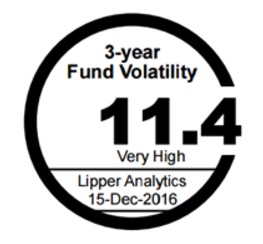
Then, I explained further on how Bryan is able to interpret the icon. As I interpret, I wrote the following notes:
- It is a FVF disclosure for 3 years up to the current date of December 15, 2016.
- The FVF value is 11.4. This means, there is a possibility for the fund’s returns to rise and fall around 11.4% relative to the average return.
- When it comes to classification of unit trust, there are 5 categories which include ‘Very Low, ‘Low’, ‘Moderate’, ‘High’ and ‘Very High’.
- This fund is classified as ‘Very High’. This means, it is residing within the highest 20% FVF among all qualified funds and thus, may suggest that the fund is adopting strategies which are more aggressive in attempt to achieve high returns.
An hour has passed swiftly. Bryan seemed to be impressed. After collecting his thoughts, Bryan commented, ‘This is amazing, cousin. It looks like I’ve got plenty more to learn about investing.’
I replied, ‘So do I. Well, there is a place where investors like us can receive education about investing.’
This article is sponsored by Securities Commission Malaysia, under its InvestSmart Initiative.


© Securities Commission Malaysia (SC). Considerable care has been taken to ensure that the information contained here is accurate at the date of publication. However no representation or warranty, express or implied, is made to its accuracy or completeness. The SC therefore accepts no liability for any loss arising, whether direct or indirect, caused by the use of any part of the information provided. The information provided is for educational purposes only and should not be regarded as an offer or a solicitation of an offer for investment or used as a substitute for legal or other professional advice. For enquiries regarding sharing, republishing or redistributing this content please write to: admin@investsmartsc.my.

21 replies to "4 Factors to Consider before Investing in Unit Trusts"
is it possible to invest in a Unit trust that is outside one’s country? if the answer is yes. do you have one?
Yes kaps, its possible to invest outside. Asean or EU as examples. And, at Public Mutual, we have many options for you. Just, we need to know more, about your suitability and needs in investment. Please reach out for me, if you interested to know more. so glad can be a help. (Khadijah- 0111-8514948)
Yes definitely, if you have found a unit trust DIY investment platform such as Fundsupermart or Phillip Mutual Bhd. I have written an article on why you need to consider using Fundsupermart as an investment platform in https://wisefocusblog.com/2017/07/10/7-strategic-reasons-why-investing-through-fundsupermart-unit-trust-is-a-better-choice/ Welcome to take a look at it.
I have a question regarding MER and how it affects the investment return. Let say a unit trust co publish a performance table which shows after 5 yrs the return is 60%. Does it mean, if i invest 10K (net after sales charge), I will get 16K ? Or that 60% have not discount the MER ? Meaning I will get less than 16K. If so, please show how it is being calculated assuming MER of 1.5%.
In certain case, the table shows the annualised return say, 10% and MER of 1.5%. Does it mean the final return after 5 yrs is being calculates as 10K*(1 +0.1)^5 or 10K*(1 + 0.1-0.015)^5.
This question have bother me for some time, really appreciate your clarification.
The unit price or NAV you see published each day has already factor in all the expense (inclusive of trustee and management fee)
Thank you for the valuable information
Where can we find these 4 factors?
Hi Connie, in the article it was stated by KC:
I mentioned, ‘These NAV, MER and other stuff that I’m about to share are available in the prospectus of a unit trust fund.’
Answer: You will find these factors in the Prospectus of the fund.
nice article… can you explain what is private retirement scheme (prs) ?it is same with unit trust or not?
Hi Azuan, PRS is very similar to UT. Investment wise, it works the same. But PRS has its advantage – tax relief. The disadvantage is that it is meant for retirement and you can’t liquidate it in the short term.
I can explain further Mr Azuan. As I have invested in both and plus I have license for selling unit trust and private retirement scheme from FIMM. Do contact me at 0111-8514948.
Good tips. Still contemplating how to invert in trust fund.
Good question, you may reach to any registered unit trust consultant with FIMM. and Im the ones, Mr Arumugam.
The information given by KC Lau here is a professional advice. Do you want to hear from a non professional practitioner’s advice or a practical Unit Trust investor’s advice from experience? You may go to https://wisefocusblog.com/2017/02/28/first-blog-post/ for your reading and tips for using Unit Trust as your investment vehicle for life. Please browse through the section on Unit Trust Investment Strategy. You will find a lot of insight there. If you have further question, please feel free to write to the author there.
When do u sell unit trust? Assume after 5yrs investing made a return of 35% do i redeem or just leave it be?
That depends on the objective of your investment. Does the fund still fit well in your portfolio for your purpose of investment, like retirement, child education etc?
You can consider doing portfolio rebalancing – like switching some gain-making fund units to other types of fund to rebalance it.
you are absolutely right Mr Lau. It all depends on your investment objective. If the investment has gave your return that you expected. You are better redeem or switching to other fund. the fund might reached the maximum NAV that the fund can go. Dont be greedy, else you will lose more.
wow 35% return after 35 years, mr wong? what a good return. you have made good decision in investing in unit trust in the first place. May i know from which unit trust provider? If you not mind to share. Thanks :)
Unit trust investment is real investment. We have to be active and understand what we are really investing. Make sure that when we invest through Unit Trust, we are investing into the market, not the fund alone. For further reading and understanding, you may visit … https://wisefocusblog.com/2018/11/26/what-does-it-mean-to-have-long-term-investment/ Do read other related article on unit trust investment there.
Nice article, thanks for sharing.
I am new to the Unit trust and this really helps me to understand better in investment.
hi Yageo, me too. I have invested since 2015. and i was investor, and now I am consultant since I dont want to keep the goodness just for me and wanted to share the benefits to others as well. please contact me, if you interested in unit trust.