

Once, there was an MBA student. Upon writing a business plan, he assembled a team and started an e-commerce site known as MercadoLibre, which is Spanish for “free market”.
That student was Marcos Galperin in Argentina back in 1999. Since then, MercadoLibre expanded its presence to Brazil, Mexico and many other nations across Latin America (LatAm). To offer a more seamless user experience, MercadoLibre developed and launched many other services that are integral to merchants and online shoppers. They include digital payment, logistics, and advertising. Today, MercadoLibre runs the largest online commerce ecosystem in LatAm. Listed in the US, its market capitalisation stands at US$ 118.9 billion.
In this article, I’ll list down 6 things that I learnt about MercadoLibre after I read through its annual reports. They are as follows:
1. Ecosystem
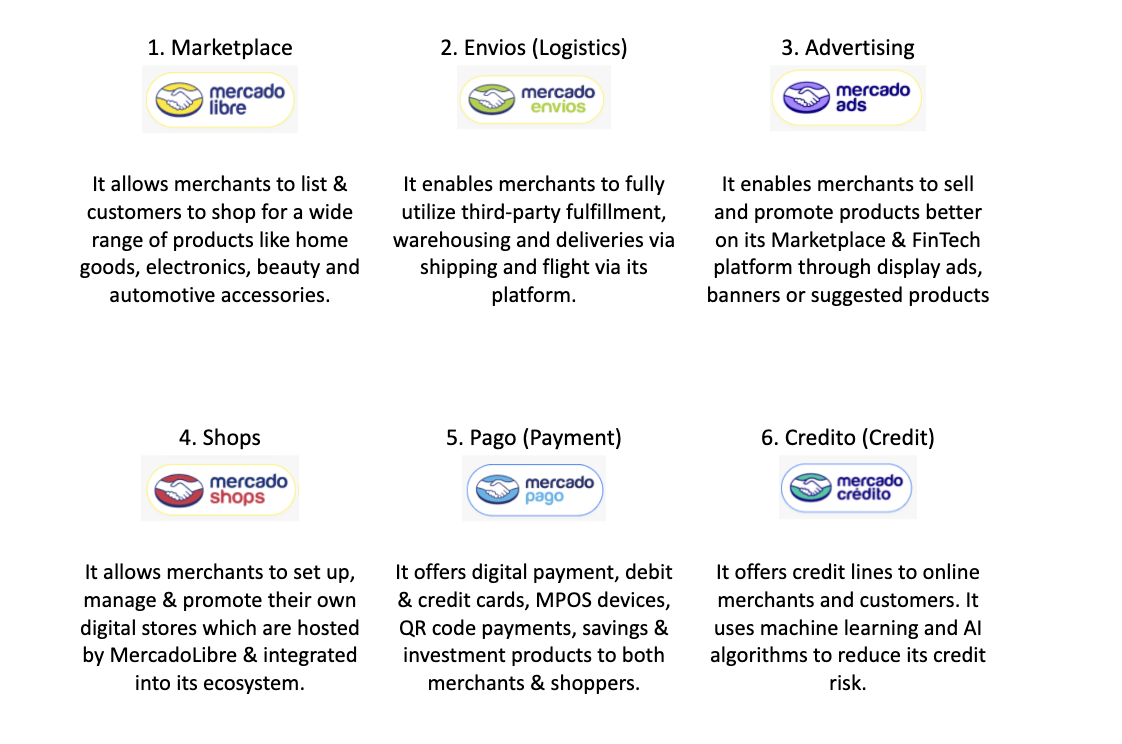
MercadoLibre’s ecosystem features 6 different service offerings to its users:
2. Operating Metrics
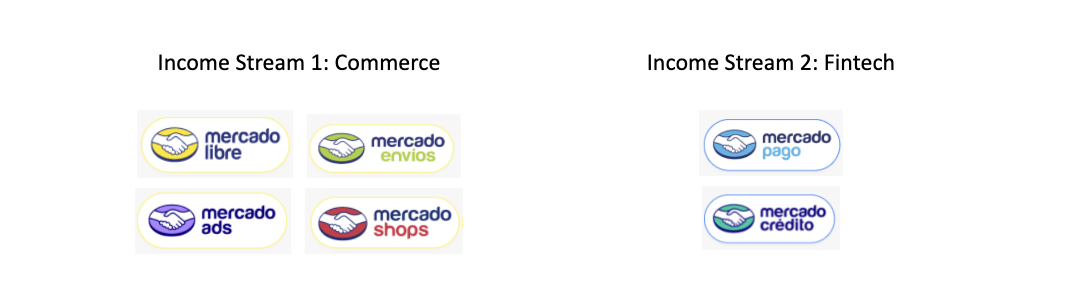
MercadoLibre categorizes its 6 different service offerings into 2 income streams namely: Commerce and Fintech. Its commerce would include revenues that are generated from its marketplace, logistics, advertising and shops. Meanwhile, its Fintech revenue would stem from payment and credit.
The key success metric for commerce is Gross Merchandise Value (GMV). As for Fintech, its operating metric is Total Payment Value (TPV). In the last 10 years, it achieved a CAGR of 21.91% in GMV and 49.61% in TPV. MercadoLibre increased its GMV from US$ 7.1 billion in 2014 to US$ 51.5 billion in 2024. This was in line with substantial growth in the amount of products sold and shipped during that period. Its TPV has increased from US$ 3.5 billion in 2014 to US$ 196.7 billion in 2024.

3. Key Geographical Markets
MercadoLibre operates in LatAm, where its total addressable market is as much as 500 million in combined population where the e-commerce penetration rate for this region is a little more than 10%, which is 2.0-2.5x lower than the United States, the United Kingdom and China. Presently, although it has presence in 18 nations across LatAm, Mercadolibre generates the bulk of its net revenues from 3 countries: Brazil (54.9%), Argentina (18.4%), and Mexico (22.4%).

4. Profitability
In line with MercadoLibre’s growth in GMV and TPV, its net revenues grew from US$ 473 million in 2013 to US$ 14.5 billion in 2023, which is a CAGR of 40.8%. It had recorded little profits in 2013-2017 and losses in 2018-2020 despite growth in net revenues. This is due to significant growth in product development, sales and marketing expenses incurred during the period, which had contributed to a continuous expansion in its ecosystem and net revenues in that period.
In 2021-2024, MercadoLibre had recorded growth in profitability resulting from its continuous growth in sales and better margins in the 4-year period.

5. Key Risks
1. Political Risk.
2. Foreign Exchange Risk.
MercadoLibre operates in LatAm, where nations may be politically unstable and have a history of making significant changes in economic policies & regulations. Some of these countries have experienced rising crime rates, violence & as well as social unrest. MercadoLibre incurred a one-off loss from Venezuela for it had decided to exit its e-commerce business in that nation in 2017. Although it now reports its financials in US Dollar, MercadoLibre is exposed to FOREX risk for the company’s operating currencies are in Brazilian Real, Argentinian Peso, and also Mexican Peso. Of the 3 currencies, the Argentinian Peso is one that depreciates hugely against the US Dollar as the country is going through a monetary crisis.
6. Valuation
The key metric to value MercadoLibre is Price-to-Sales Ratio (P/S Ratio). Here, it is not viable to use P/E Ratio as MercadoLibre barely reported net income as its management team allocated most of its gross profits on development and sales of new products, which expanded its ecosystem during the period. For the past 10 years, MercadoLibre’s P/S Ratio had averaged at 9.16 (2015-2024). It means, investors are willing to invest on average US$ 9.16 for every US$ 1 in revenues.

Conclusion:
MercadoLibre had “sacrificed” profitability in search of expansion both in terms of ecosystem and market share across LatAm. It brought in consistent growth in GMV and TPV, which in turn, led to its CAGR of 43.61% in net revenues over the last 10 years. This is the contribution factor to a CAGR of 29.35% in growth over the past 10 years in its stock price, up from US$ 129.73 in 2014 to US$ 1,700.44 in 2024.

Source: Google Finance
It’s key for investors to appreciate MercadoLibre’s growth trajectory, its focus in allocating capital and the main risks involved (political and Forex) in order to be objective on its investment potential. Also, one needs to take note of valuation. While MercadoLibre continues to deliver strong revenue growth, it is important to not pay a high P/S Ratio for its shares (like in 2020 when P/S Ratio was 20). In most cases, it’s ideal to keep P/S Ratio low in order to have a margin of safety.
Here, if you intend to build a Growth-based Portfolio filled with the top 1% companies listed in the United States, check out our free 1-Hour online webinar training on growth investing:
