

As movement restrictions had been lifted, I had started travelling both locally & abroad. I’ll compare hotel room rates at both Booking.com and Agoda to search for the best possible deals before booking them. Little did I know that these are actually owned by the same parent company: Booking Holding Inc. Today, it has a market capitalisation of US$ 180+ billion, making it one of the fastest growing online providers of travel-related services in the world. Here, I’ll make a list of 6 things about Booking that one should know before investing:
1. Brands
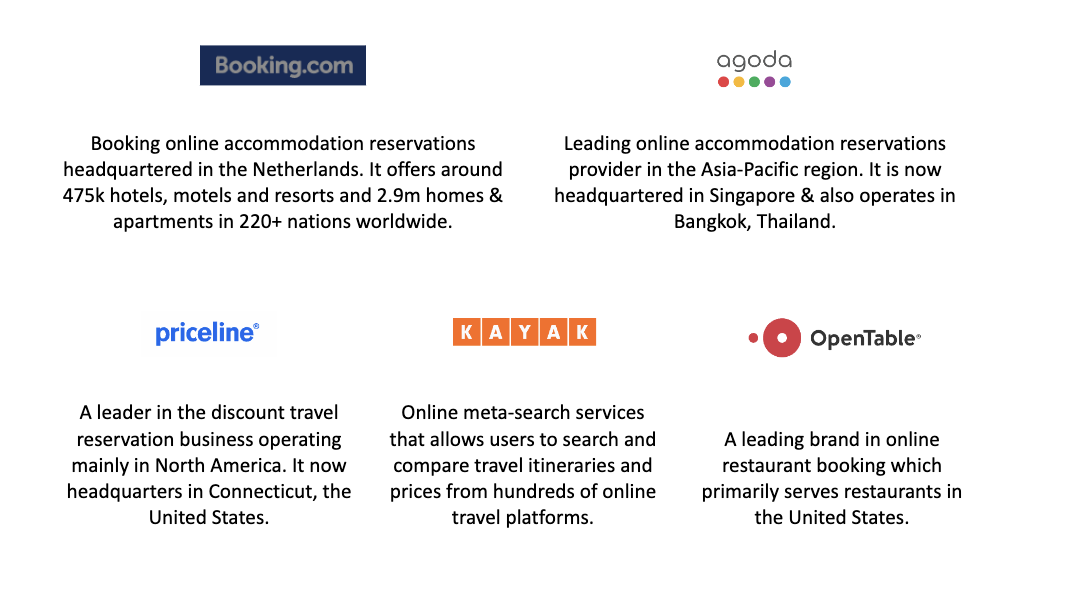
In addition to Booking.com and Agoda, Booking owns Priceline, KAYAK, and also OpenTable. Priceline allows users to reserve hotel rooms, car rental, flights, and activities. KAYAK offers invaluable travel guides, tips & recommendations. As for OpenTable, it allows diners to book their restaurants worldwide.
2. Gross Travel Bookings
Booking has recorded continuous growth in hotel room bookings worldwide for the last 10 years. The exception is in 2020 as travel was restricted both locally & worldwide due to the COVID-19 pandemic. In 2014, Booking managed a total of 271 million room nights. This number has increased to 1,144 million in 2024. As such, it has contributed to a CAGR of 12.7% in gross travel bookings, rising from US$ 50.3 billion in 2014 to US$ 165.6 billion in 2024.

3. Profitability
Booking has 3 income models. First, Booking facilitates payments done by users when they book hotel rooms, flight tickets, car rental and other services related to travel. Second, Booking earns commissions from hotel rooms, car rental, and flight reservations made by its users. Third, it earns advertising fees from KAYAK for advertisements placed and from OpenTable for its reservation and a suite of management services to restaurants.
In line with gross travel bookings, Booking has recorded consistent growth in its revenue and net income until 2020 as a result of the COVID-19 pandemic. Since then, Booking started to recover in terms of revenue and net income for travels had started to recover as the pandemic situation gradually improved in 2021. In 2022-2024, despite its strong recovery, Booking’s net income has yet to recover to its 2019 level.

4. Capital Allocation
In 2015-2024, Booking generated US$ 47.1 billion in operating cash flows. It has raised US$ 12.4 billion in debt and US$ 5.9 billion in net sale of investments. So, the sources of its cash inflows are 72.0% (operating cash flows), 19.0% (debt) & 9.0% (net sale of investments). Of which, Booking had allocated its cash inflows in the following manners:
a. US$ 44.8 billion in net share buybacks
b. US$ 5.0 billion in acquisitions and other equity investments.
c. US$ 3.2 billion in capital expenditures.

5. Equity Investments:
As of 31 December 2024, Booking has 2 key equity investments as follows:
a. Grab Holdings Ltd. Booking now has an interest in Grab which is worth a total of US$ 200 million. Grab is Southeast Asia’s super app which enables deliveries, mobility and financial services in 800 cities across 8 countries in Southeast Asia. Grab narrowed its net losses from US$ 3.45 billion in 2021 to US$ 105 million in 2024.

b. Didi. Booking’s interest in Didi is worth US$ 179 million. Didi offers a range of app-based services like ride-hailing, taxi hailing, chauffeur, food delivery, and as well as financial services across Asia-Pacific and Latin America regions. Didi had recorded RMB 1,258 million in net income in 2024 which is its first profitable year after a string of five net losses years in 2019-2023.

6. Valuation
Booking had relatively poor years in 2020-2021 due to COVID-19. Thus, it would be sensible to exclude P/E and P/OCF Ratios for these 2 years. Upon doing so, in the last 10 years, Booking has an average P/E of 27.4 and average P/OCF of 17.6 (2015-2024).
Conclusion:
Booking has delivered a strong set of operating and financial results prior to the COVID-19 pandemic. In 2020, travel restrictions around the globe had impacted Booking and thus, such remains a key risk to investors. Since then, the company had recovered well and recorded US$ 5.9 billion in net income. As investors, the key consideration would be on risk acceptance. If such risk is acceptable, investors could calculate its latest valuation ratios (P/E & P/OCF Ratio) prior to making a decision on it.
Here, if you intend to build a Growth-based Portfolio filled with the top 1% companies listed in the United States, check out our free 1-Hour online webinar training on growth investing:
