
Knowledge is not power. Knowledge is only powerful when you apply it.
Roadmap to Financial Freedom is an intellectual model that I have developed to provide comprehensive, holistic and lifelong ‘big picture’ for an individual to make decisions and take actions to achieve his financial freedom. When developing the Roadmap for a client, I take into consideration the client’s five essential elements of financial freedom: spending, inflation, ROI, time and saving.
In addition, the calculation also takes into consideration of personal information such as age, number of children, EPF, various financial goals, various sources of income and various forms of assets and liabilities. Certain reasonable assumptions have also been made in order to complete the full picture of an individual’s financial position. The purpose of the Roadmap is to give an individual an indication of where he stands on his journey to arrive at financial freedom.
Let ’s look into the case of George:
- He is 36 years old and his wife is 34 years old
- He has two children aged 8 and 5
- He works as a senior manager in a multinational corporation with an annual income of RM120,000. His wife works as an administration manager with an annual income of RM100,000
He has the following financial assets:
- House – RM500,000 with a RM250,000 mortgage loan
- Unit Trusts – RM30,000
- Bank Deposits – RM200,000
- EPF – RM200,000 (himself), RM150,000 (wife)
- He and his family currently enjoy a life style of RM120,000 per year, excluding mortgage repayment, insurance premiums and income taxes.
- He and his wife intend to retire at 55 with RM96,000 living expenses per year up to age 80
- They would like to provide RM200,000 each for their children’s tertiary education.
By looking at George’s financial information, do you think he will be able to achieve his financial freedom goal?
It is not easy to answer this question, and the solution can’t be found offhand. The best way to answer this question is to plot a Roadmap to Financial Freedom for George.
After keying George’s personal information, his Roadmap looks like this:
Current Roadmap to Financial Freedom for George

The Y axis of the chart represents George’s net worth. The X axis of the chart represents his age. From the roadmap, we can see George’s net worth will grow to about RM400,000 when he is 45. His net worth drops to almost zero at age 46 when his first child enters university. Then, his net worth will grow slightly but drop to zero again at age 49 when his second child enters university. His net worth stays at zero until he reaches 55 and withdraws his EPF money. Then, his net worth grows to about RM1,100,000. At age 57, his wife withdraws her EPF money and their family net worth grows to about RM2,450,000. From there, their net worth continues to drop. Their net worth becomes zero when George is at age 65. In another words, George’s wealth will run out by the time he is at age 65.
Based on George’s desire to have his wealth last until age 80, the roadmap clearly shows that George’s current money management will not achieve all his financial needs and wants. In another words, George will not achieve his financial freedom.
WHY HAVING A ROADMAP IS IMPORTANT?
It is important for each of us to have a Roadmap to Financial Freedom to help us translate our financial freedom dream into a coherent set of financial performance measures. With the roadmap, we will be able to measure our progress towards our goal of financial freedom.
With the roadmap, we will know where we stand now on our journey to financial freedom destination. Unless and until we know where we stand now, we will not be able to take the necessary actions to move towards our destination: financial freedom.
Without a Roadmap to Financial Freedom, you will not know if you have enough financial resources to meet all your goals. Without this knowledge, you may continue to over-spend and under-save. When you realise the problem at age 50 or 55, it is certainly more challenging but it is not too late to take action and enjoy the effect of compound interest.
Without this knowledge, you may also continue to over-save and under-spend. This is what we mean by compulsive saving. This is not as bad as under-saving. But let’s say that you realise that you have over-saved when you are 55. There is no way you can turn back time to age 40 to spend on something you wished for at that time that could have improved your quality of life.
In short, managing your personal finances without the Roadmap to Financial Freedom is like shooting at a target in the dark. You don’t know where the target is and you don’t know whether you have hit the target or not.
Let’s look back at George…..
Now that George knows his current roadmap, he will be able to take action and reprioritise his financial needs and wants to achieve his financial freedom. First, he can restructure his investment portfolio to achieve a higher ROI. His current investment’s ROI is 3.8%. If he is able to achieve a 9% ROI for his investment portfolio, his roadmap will look like this:
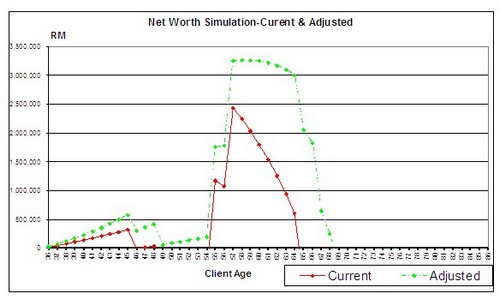
After increasing his ROI, George’s net worth will last longer, up from age 65 to age 68. Although this is better, it is still not good enough. After all, George’s wish is to have his money last beyond age 80.
Next, George will need to reprioritise and adjust his financial needs and wants. He may consider to reduce his spending on living expenses during his retirement from RM96,000 to RM84,000. It means about RM12,000 less per year which is equivalent to RM1,000 less per month. If George is willing to make the adjustment to make his wealth last longer, his roadmap will look like this:
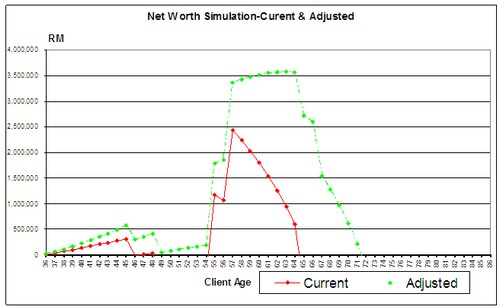
After reducing his expenditure on living expenses during retirement, George’s net worth will now last to age 71, still some 10 years shy from his target of 80 years and beyond.
Based on the adjusted roadmap, George now needs to also adjust his spending on his current lifestyle to increase his savings. If he is able to reduce his current spending per year from RM120,000 to RM105,000, giving him an additional RM15,000 in savings per year, his roadmap will then look like this:
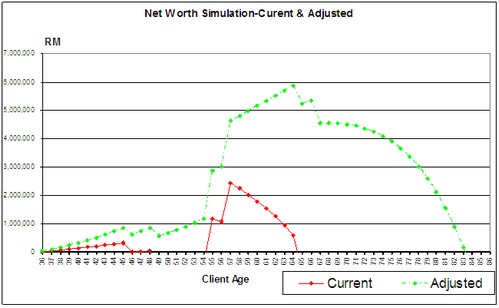
After reducing his current spending to save an additional RM15,000 per year, George’s net worth will now last up to age 83. By making those adjustments George is now able to achieve his own financial freedom.
The above is just one example of how a tailor-made Roadmap to Financial Freedom can help a person realize his or her financial goals. Through the roadmap, George now knows how various current actions and adjustments will impact him financially. George also knows how he can derive an optimum lifestyle for him and his family without compromising on his financial freedom goals.
3 Levels of Financial Freedom Planning
Based on George’s story, we can see that there are actually 3 levels of financial freedom planning:
1. You don’t know where you stand in your journey to financial freedom.
2. You know where you stand today on your journey to financial freedom but don’t know how to optimise your wealth to achieve financial freedom.
3. You know where you stand in your journey to financial freedom and you know how to optimise your wealth to achieve financial freedom.
If you are serious about achieving your financial freedom, it is imperative for you to know your current level today so that you can move yourself to the third level of financial freedom planning. You can only achieve your true financial freedom if you manage your wealth from level 3. If you remain at level 1 and 2, it is almost impossible to achieve your financial freedom.
This article is written by Yap Ming Hui, Financial Coach and author of 5 best selling books on personal finance. To find out how you can produce an Optimum Roadmap to Financial Freedom , and learn more tips and resources on Money Management, please visit www.yapminghui.com.

5 replies to "The Roadmap to Financial Freedom – How to get from where you are to where you want to be"
hi. I am a US citizen living in Honduras. I work among the poor. they are needing very BASIC teaching in finances. they make very little and don’t have the means in this economy to, for example, buy insurance or invest as we know it. do you have any info you could share with me in order to teach these principle? thanks.
Hi, I purchased the book, but I just wonder, is there a tool out there that can help me to produce the road map?
Yap Ming Hui and his team designed the tool which is only available for internal use. They use the tool to do financial plan for their customers.
I think it’s dishonest to sell a book that is only a veiled marketing tool for a proprietary software. It may be a great introduction to how a particular group of wealth advisers approach things but I think it’s little more then that. In a civilized country, I would demand a refund. But this is Boleh-land. What to do.
Hi,
I somehow do not understand why George’s house is considered an asset here. This is the house where George will be staying until his old age. If the time comes when he needs the money (when all other sources have run out), does he have to sell the house? If he has another property, then he disposed of that property for money.
I actually disagree putting the house as an asset when it is the home for the family to live in as I cannot imagine selling the house later on when my other funds are not enough to fund my retirement. Therefore, the house(family home) value should be excluded when calculating whether George has sufficient financial resources to fund his retirement later on.