
DIBS has been in the news lately. Let’s have a look at what it is in more detail.
DIBS is an acronym which stands for “Developer Interest Bearing Scheme”. It was introduced several years ago, around 2009, as an incentive to warm up the new property market which was somewhat cool at that time.
Looking back, it’s safe to say that the “warming up” objective was achieved. In fact, the property market grew so hot as a result of DIBS (in combination with other incentives), that it began to literally sizzle! ?
So, how come DIBS was such “hot stuff”?
Well, simply because DIBS allowed the ordinary wage earner, to easily own property. When previously, a purchaser had to have the cash in hand pretty much, in order to pursue a property investment portfolio, measures such as DIBS allowed purchasers to leverage their cash in such a way that many could purchase properties which would normally have been beyond their reach.
What’s DIBS?
Essentially, DIBS is a type of financing offered by a developer. Let us say, that the Buyer is purchasing a property under construction from the developer (or, off the primary market). For illustration purposes, let us assume that it will take several years for construction to be completed. Meanwhile, the Buyer has signed the Sale & Purchase Agreement (“SPA”) and obtained a loan from the Bank. What should normally happen from that point onwards is that the loan needs to be serviced by the buyer. But under the DIBS arrangement, the Buyer would not have to service that loan until the property has been built, and vacant possession has been delivered. The Developer “absorbs” the costs during the interim period.
Of course, this makes for a pretty convenient cash-positive arrangement for the Buyer. Before the introduction of this scheme, the Buyer would have had to pay a steadily increasing sum to the bank as a larger portion of the loan he took to buy his new property, was disbursed. This meant that only those with available cash in hand, could venture into the property market as they would face the financial burden of servicing the loan, while the unit was under construction (and therefore, could not be rented or used to generate revenue).
Coupled with Additional Discounts and Rebates
Not to mention, Developers would throw in additional discounts – even on the 10% deposit . A horde of “Flippers” emerged, namely purchasers who would purchase properties under a heavy discount, take advantage of schemes like DIBS, and then flip the property to subsale buyers within the construction period or once vacant possession is delivered, making a handsome profit in the meantime.
As a result of DIBS and other corresponding incentives, property hunters rejoiced in glee and lined up for hours at every new property launch, snapping the units up as fast as packets of nasi lemak. Launches were fully sold out in minutes. Buying property was as easy as buying goreng pisang at the corner stall. Every property launch was like a feeding frenzy, with crowds coming from far and near in droves to buy, buy, buy. The demand for properties skyrocketed beyond imagination.
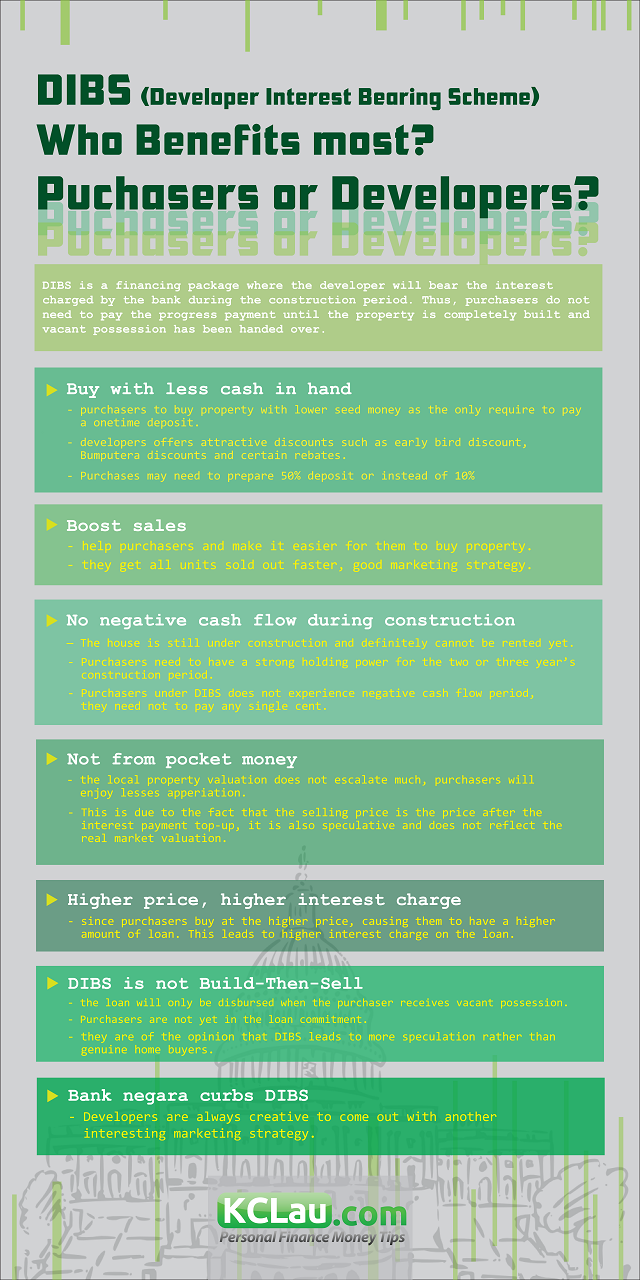
Downloads
 Developer Interest Bearing Scheme (DIBS) Explained - Infographic
What's DIBS?
How purchasers and developers both benefit from DIBS?
Why is DIBS abolished and how it will impact the property sale?
Is DIBS noble?
But was DIBS really a philanthropic/CSR exercise on the part of the Developers to “help” the Buyers, out of the kindness of their hearts?
Well, not exactly! As we know, there is no such thing as a free lunch. In reality, the so called “absorbed” costs of servicing the loan during the construction period, were of course offloaded back on to the Buyer through higher property prices owing to the hidden capitalization of the interest or rather, the Developers having factored their portion of the costs, into the launch prices of the properties. To make things simple, the true cost of owning the property, that is the retail price plus the interest costs, was then simply advertised as the retail price. The eager purchaser was usually none the wiser and rushed out to buy the properties anyway.
The effect of DIBS
The result? Properties sold under the DIBS scheme, would not necessarily reflect the true market price in that area. Instead, they would be inflated by around 20% or so. The so-called justification to the purchasers, was that the retail price took into consideration “future appreciation” potential. In a way, the Buyer ended up buying a lottery ticket. If he was lucky, the price would appreciate upward and that future value would become the actual transacted price for such properties. If he was unlucky, he would be stuck with a property for which the market valuation remained lower than his original purchase price.
In summary, this practice allowed for speculative pricing to run rampant. Properties on the primary market were not sold based on market value, but on an inflated value which factored in, amongst others, the interest on the loan which the Developer would initially bear. Prices of property began to spiral upward left, right and centre. The spillover effect also affected the subsale market. Sellers began to ask for ridiculous prices not just in prime areas but also in areas which were hitherto considered in the “outskirts” of KL. Many homebuyers were caught in a vicious cycle. The more they relied on schemes like DIBS to help them buy property, the higher the prices skyrocketed, and the higher the prices skyrocketed, the more they needed to rely on schemes like DIBS.
NO MORE DIBS?
So fast forward to October 2013, when the 2014 budget was delivered. Obviously, alarm bells were ringing at the top, and Bank Negara Malaysia announced that banks would not be allowed to finance any projects offering DIBS or any other interest capitalization scheme.
The fire immediately cooled under the sizzling property market hot plate. Analysts projected that the abolition of DIBS and corresponding incentives would be a heavy blow to the property sector and would put a damper on the market for new properties/primary market.
So, the question is whether it may have the effect of positively impacting the secondary market, which has been sluggish owing to schemes like DIBS. It’s possible that buyers may turn once again to this neglected sector of the market, as they are no longer able to purchase properties on the primary market with such ease.
Either way, the property market is likely to cool down. Perhaps, it is indeed a good time to stay cool and and wait to see how it pans out in the year ahead.

1 Response to "DIBS – Property Purchasers’ Friend or Foe?"
thanks for the info,
both bad and good of this DIBS. Please continue sharing