

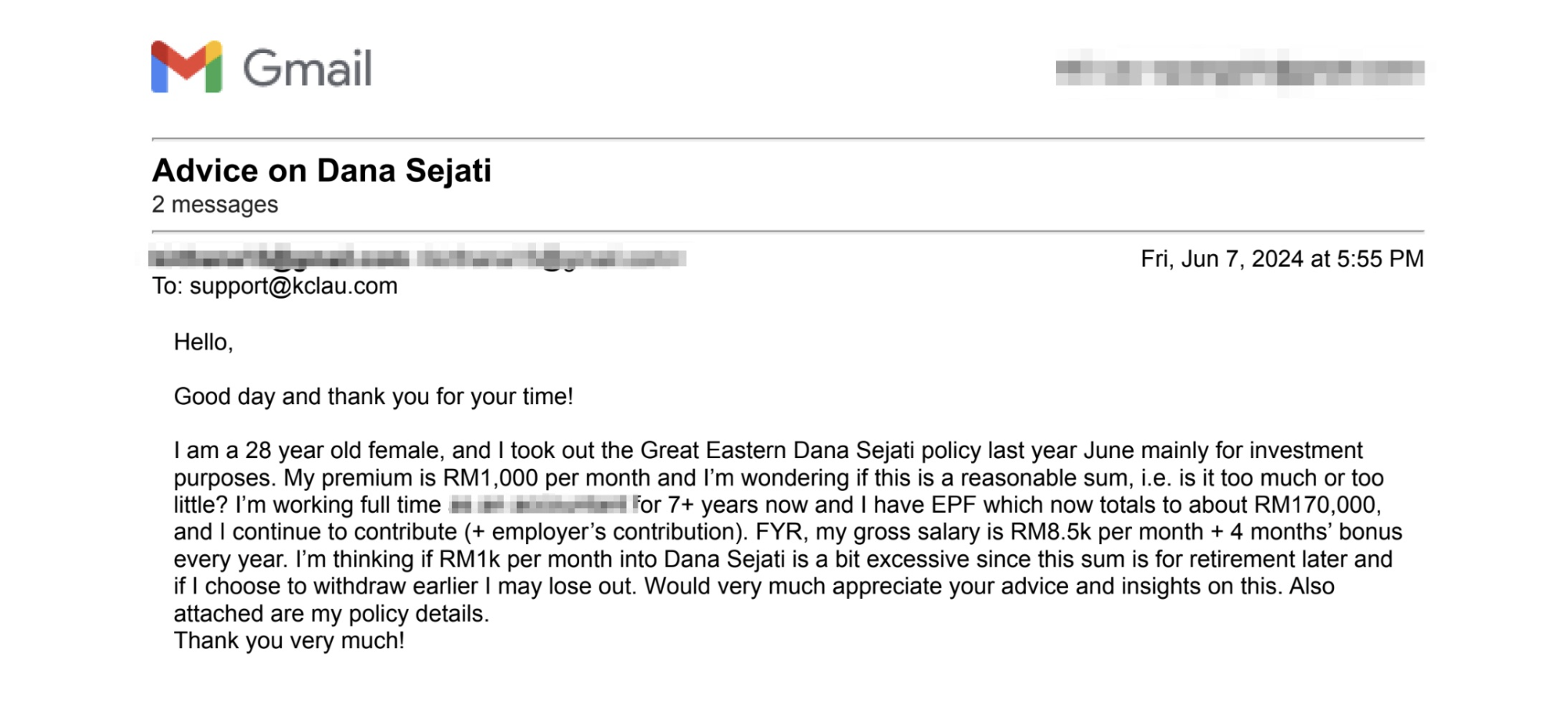
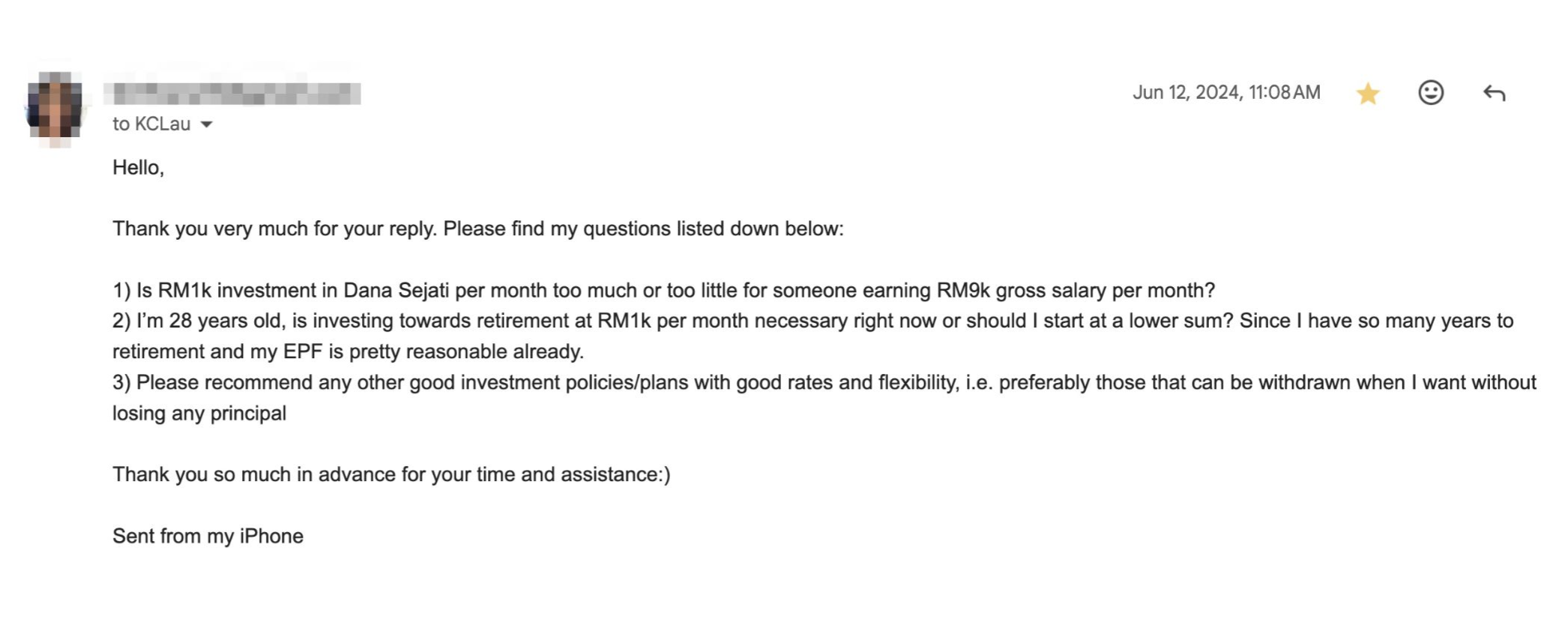
Here are screenshots received by KC Lau where the questioner asks of his views on her RM 12k a year investment into Dana Sejati:
Source: KC Lau
Here are some discussion points to the above email exchanges:
1. Financial Status
First, at 28, the questioner (let’s call her Sally) makes RM 136k in yearly income. She also has RM 170k in her EPF account. That’s remarkable.
Now, in her second email, she asks if investing RM 1k per month to build up her retirement nest egg is excessive. To this, it depends on her circumstances. What are her living expenses and debt commitments? Is she single or married? These are factors to be considered. Here, let us make a wild guess. She’s single, frugal, and has little debt commitments. In such a case, she may invest RM 1k a month or even more for her retirement. So, RM 1k a month isn’t excessive.
2. Insurance for “Investment”?
Insurance pays medical bills and offers financial relief in times of need. It would help us to keep most (if not all) of our personal wealth intact in our piggy banks without needing to break it. Insurance offers financial peace and security. But is it an investment that accumulates wealth? Nope.
Take a look at Sally’s insurance policy document. She bought her policy last year in June, committing to “invest” RM 12k per year. After 20 years of “investing”, it is shown on her quotation that her investment value could grow to RM 253,987 based on Scenario X or RM 338,728 based on Scenario Y at Year 20 (at age 48).
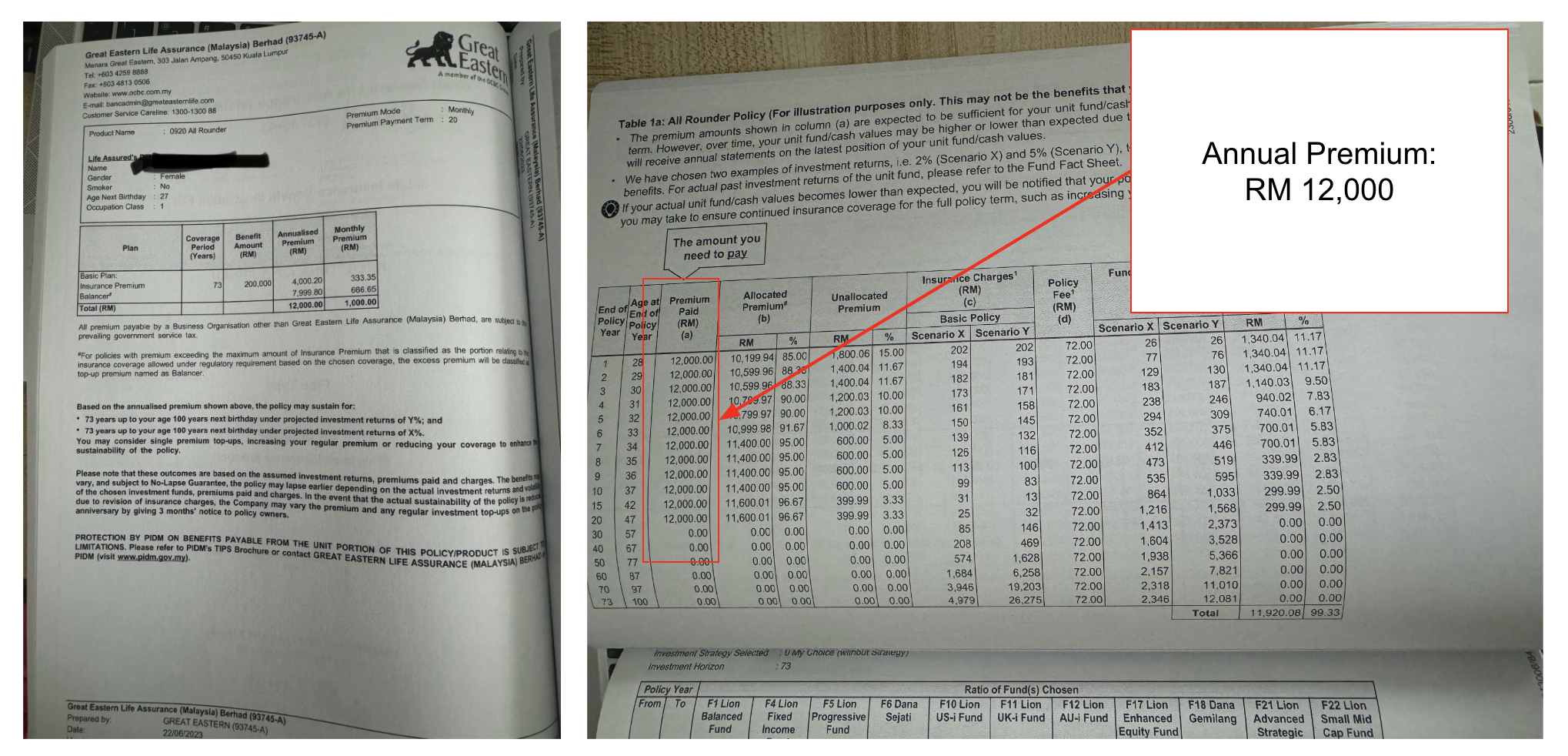
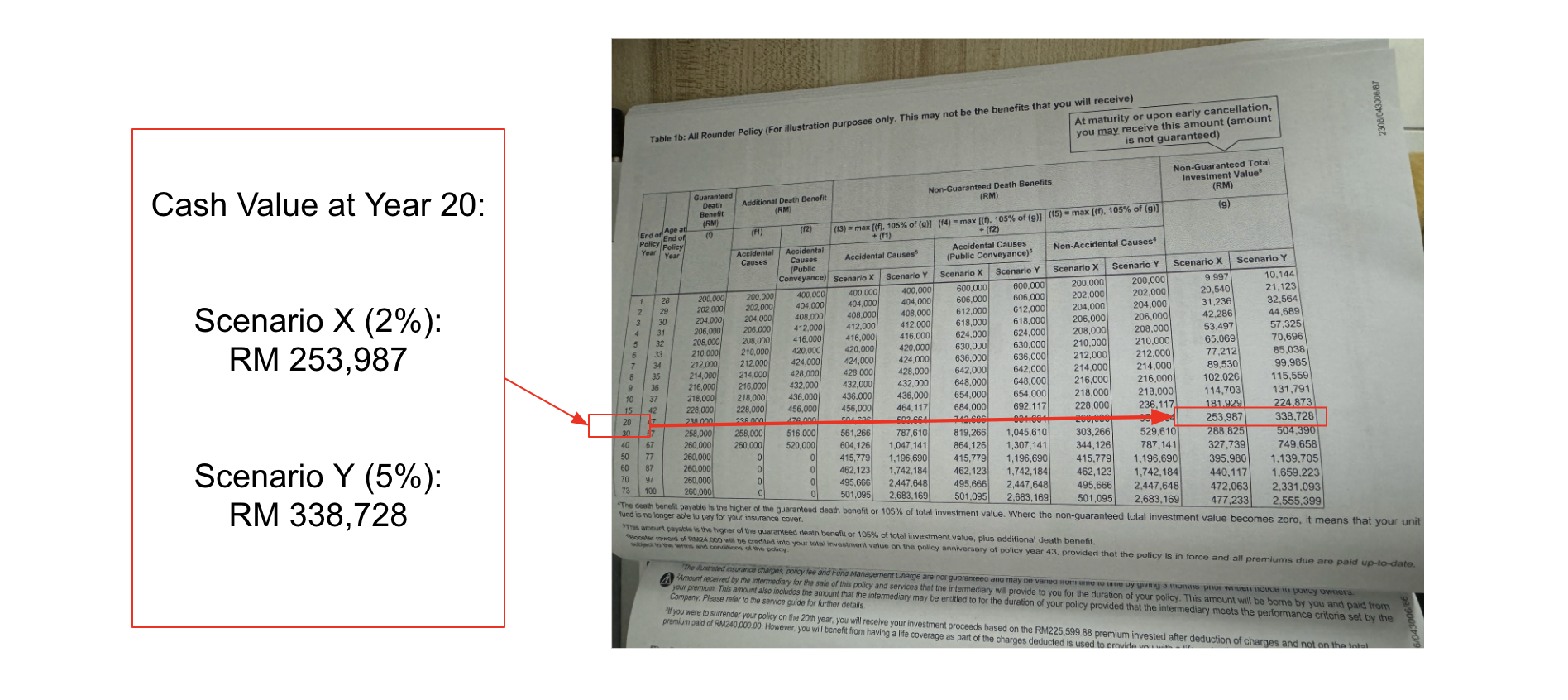
Guess what her “investment returns” based on Scenario X and Y after “invested RM 240k for 20 years”.
For Scenario X, her investment return is 1.90% a year for 20 years.
For Scenario Y, her investment return is 3.48% a year for 20 years.
Would you want to invest and earn 3.48% a year for 20 years? Here, it is indeed crystal clear that Sally is purchasing a product that is not ideal for her objective, which is to build up her retirement fund.
3. EPF
Can you imagine what if Sally chooses to stash RM 1k per month into her EPF?
Historically, EPF delivered 5+% to 6+% in annual dividend yields over the last 10 years. Moving forward, if EPF continues to pay out 5% dividend yields a year for the next 20 years, Sally’s “RM 240k in capital” would grow to RM 396,789. Now, if EPF delivers 6% dividend yields a year, her capital could grow to RM 441,427.
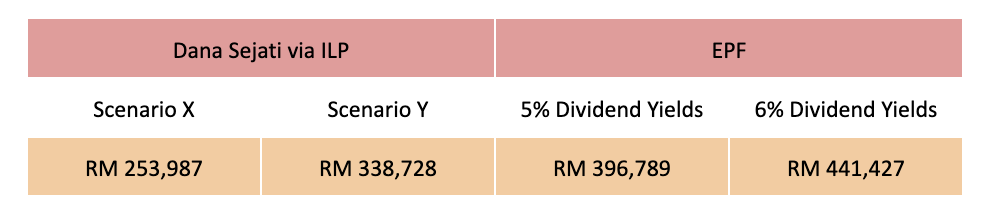
Sally could be having RM 58k-RM 187k less in 20 years in retirement funds. This is not just it. Imagine after 20 years, when she is 48 and added RM 396,789 into her own EPF account (5% dividend yield), Sally’s EPF would consists of:
a. Original RM 170k in EPF (current)
b. RM 396,789 (20 years of RM 1k a month EPF contribution)
c. RM X (EPF employee + employer contribution for 20 years).
It’s possible for Sally to have RM 1+ million in her EPF account at 48 years old. If it pays out 5% in dividend yields a year, that amounts to >RM 50k in dividends a year.
4. If I’m Sally
It’s practical to admit this mistake. Instead of “investing” in the policy, Sally may consider cutting her losses by surrendering her policy or substantially lower her monthly premium, if she wishes to restructure it into an insurance policy. There would be a sunk cost of a few thousand Ringgit for she bought it for a year. But, such is nothing compared to the potential RM 58k-RM 187k lower in retirement funds (if Sally continues on).
Not forgetting: the potential of EPF dividends loss arising from her investment.
5. Are There Other Investments than EPF?
Think about Sally. She earns good money but isn’t educated on investing. To her personally, she lacks the skills to assess investment deals. If she is skillful, I think she won’t be asking KC for “recommendations” as she can invest independently and confidently by herself.
Conclusion:
The above is an example of how purchasing a product for the wrong reason can do a disservice to our finances. Such is the importance of financial education. In our schools, education on money matters is lacking and such breeds competent workers who can earn money but lack the skills necessary to manage it.
In closing, if you wish to learn how you control your finances better, check out our latest course: Money Hacks. The key learning points include:
a. 7 Keywords that shape the building blocks of a richer life.
b. 4 Financial Ratios to improve your finances.
c. 5-Step Financial Turnaround Plan to position yourself for wealth.
Join Now for only RM89.
Upon completion, you’ll get a Full Refund+RM 200 in Learning Credit for further learning with us.
Link:
Money Hacks
