
Instead of aiming to become the best at whatever you do, you will get more reward for your efforts if you aim to be different instead. Guy Kawasaki said that if you have jumped curve (innovatively far ahead) in your industry, you do not have to be ‘perfect’. “Don’t worry, be crappy.” He said, when you find yourself in such a situation.
Looking back now, the first iPhone was definitely not very sophisticated by today’s standards. But it was okay for Apple because iPhone was the first of its kind.
Just like what Bruce Lee wrote in his letter, “There are two ways of making a good living, one is the result of hard working, and the other, the result of the imagination (requires work, too, of course). It is a fact that labour and thrift produce a competence, but fortune, in the sense of wealth, is the reward of the man who can think of something that hasn’t been thought of before. In every industry, in every profession, ideas are what America is looking for. Ideas have made America what she is, and one good idea will make a man what he wants to be.”
If you can think of something that hasn’t been thought of before, or do something that has been thought of and talked about but has never been done before, then you will most likely move ahead faster than the rest of your competitors. Your work will definitely be more remarkable than others who are merely copying from one another.
How to be different? Do not try to be different for the sake of being different. Be different in such a way that can genuinely add more value to the lives of the people who use your products, engage your services or apply your ideas and you will have them talking about you in no time.
How to add value? First of all, you must be able to connect with the people you are trying to reach out. As the adage goes, “People will not care how much you know unless they know how much you care.” How the heck will they ever know we care for them unless we first connect with them.
Seth Godin has many bestselling books under his belt – Purple Cow, Linchpin, Permission Marketing, All Marketers Are Liars etc. One common theme that runs deeps throughout all his works is connection. Without connection nothing works.
One can never hope to be different if he or she never breaks a rule or two. In fact the more rules he or she breaks, the more likely he or she will be recognised as being different. Again, one shall never break the rules just for the sake of breaking them. If you cannot add more value by breaking a rule, you will probably be better off abiding by it.
The rule breakers
Tony Hsieh
Zappos.com, led by Tony Hsieh, is an online shoe company breaks all kinds of rules in online retailing and  the whole industry. It offers free shipping both ways and allows complete refund within 365 days.
Employees are allowed to speak to their customers for as long as they feel is necessary. This is contrary to the usual practice of other call centres who want their employees to minimise talk time but maximize sales within that time.
No wonder they cannot provide as good a service as Zappos.
The Grateful Dead
The Grateful Dead emerged out of San Francisco in 1965 and stood the test of time. Today, it has become a role model for many corporations and marketers. They pioneered many social media and inbound marketing 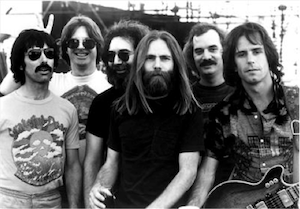 concepts that businesses across all industries apply today.
Instead of giving the sole marketing and distribution rights to their recording label, the band connects directly with their fans. Every fan is allowed to film their concerts and distribute their music freely to everyone else for whatever price they want to charge.
Michael Learns to Rock is another band that breaks the rules in marketing themselves to the Southeast Asian markets. At a time when most Western bands build their fan base in Europe and America first before they come down to Asia to do their concert tours, they target mainly at the Southeast Asian countries and managed to build a strong fan base that have other bands feeling envious.
Arnold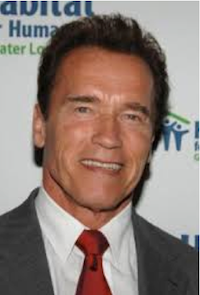 Schwarzenegger
In his commencement speech to the students of University of Southern California, Arnold Schwarzenegger talked about his six rules of success (Trust Yourself, Break the Rules, Don’t be Afraid to Fail, Don’t Listen to the Naysayers, Work Your Butt Off & Always Give Something Back). His second rule is Break the Rules about which he said, “We have so many rules in life about everything.
Break the rules, not the law but the rules. It’s impossible to be a maverick if you’re going to follow all the rules. You have to think outside of the box. What is the point of being on this earth if you want to be liked by everyone and avoid trouble. Break some of the rules.”
While serving in the Austrian Army, Arnold received an invitation to compete in the 1965 Junior Mr Europe Championship. He knew that he will not be granted leave from the Army to take part in it. But for this seventeen-year-old budding bodybuilder, this international competition was just too important an event to miss out! And if he were to take part in the following year, he would not have been eligible to do so because the Junior event was for contestants who are under-18.
After thinking it through, Arnold decided to break the rules. He went AWOL (Absent Without Leave), hopped on a Stuttgart-bound freight train, crossed the Austrian-German border and arrived just in time to compete in the event. In the end, he surprised even himself in winning the Championship. This victory was a huge confidence booster for young Arnold.
When he tried to get back into the camp, he was caught by the guard. He was sent straight into solitary confinement. A few days later, he was called to the lieutenant’s office where he was met with the lieutenant and a few other officers. It turned out that the news of Arnold’s victory somehow came to their attention. So, they wanted to hear it straight from the horse’s mouth to confirm the news.
While outwardly stern and reprimanding, these hard-nosed military men decidedly impressed. So, they sent him to the kitchen as an official punishment – to help out the kitchen staff with all the odd jobs. But as anyone who had served in the military knows, the most envious, influential and coveted department in an army camp is the kitchen department. This punishment allowed him to get all the food that he needed to build and maintain his muscles.
Arnold ‘confessed’, “Before, I felt like I was struggling on my own (such as working out when everyone is asleep), and then all of a sudden I felt like there was a team around me.” In that year, he gained 25 pounds of solid muscles and that paved the way for his future. Looking back, breaking the rules was not only inevitable for Arnold. It was necessary for him so that he could win the much needed support from even his most rigid and strictest authorities in the Austrian Army!
In the world of Chinese martial arts, strict Chinese traditions and codes of practice prevent their masters from teaching non-Chinese for fear the student will use it to bully other Chinese people. Bruce decided that such tradition was no longer relevant as he probably felt that the world was increasingly becoming globalised.
Bruce Lee
Also back in those days, every school will teach their own style and does not encourage their students to learn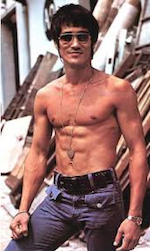 more than one style for fear of getting confused and even appear to be disloyal to their original style.
Bruce feels that different styles have different strong and weak points. So he felt it was necessary for the practitioner to combine techniques from certain styles that suit the particular practitioner.
Such approach then was also unheard of. He created his own style called Jeet Kune Do to do just that. It is only until recently that we finally have something called mixed martial arts. But Bruce had talked about it way back in the 1960s!
Lee Kuan Yew
In nation building, Lee Kuan Yew did many things that turned Singapore from a third world fishing village into a first world nation state. Broadly we can categorise them into two categories. First, Lee copied things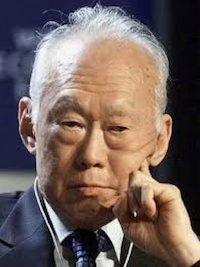 that worked for other countries and applied it to Singapore. Second, Lee had also invented countless unprecedented solutions that are unique to Singapore’s unique set of circumstances.
“All the challenges we faced have, to a large extent, been faced and overcome by others before us. All we had to do was to search them out, study them and learn from them” Lee said. He went on to mention that Dubai was also doing the same – applying what had worked for Singapore and had even managed to surpass Singapore in the process.
On other occasions, Lee also alluded to the fact that there is no a single nation like Singapore in terms of its population mix, surrounding environment and historical context and that he had to develop a solution that is uniquely Singapore and nothing short of that.
Was Lee contradicting himself? Yes and no. Either way life is full of contradictions. Needless to say, Lee understands that although modelling after and learning from those before us is important, it is even more important (especially after the initial stages) carve out a blueprint or solution that is unique to our very own context. We cannot hope to do that if we are not prepared to break some rules (and even write up some new ones) along the way!
This article was written by Ken Soong (co-author of Migrating to Australia Good Meh???, Buying a Residential Property in Australia: Eight Things You Should Know Before Doing It and Making It in Australia)
