

Lately, I’ve done some research on Ringgit Cost Averaging. Here’s what I found:
- It’s a technique where a fixed amount of capital is used.
- The investment is made on a regular basis. It could be monthly, quarterly, semi-annual or even on a yearly basis.
- The investment is made regardless of its price fluctuations.
For example, if you intend to invest in a stock,
- You will buy less quantity of shares of a stock if the stock price is high;
- You will buy more quantity of shares of a stock if the stock price is low; and
- Over time, you’ll have an average cost per share of a stock which is lower than your highest transacted price and higher than your lowest transacted price of the stock.
So, is this a good technique of investing?
It would depend on the situation. After all, we investors are individuals with different backgrounds, financial standing, preferences and investment goals. Suffice it to say, Ringgit Cost Averaging is not a one size fits all method.
If Ringgit Cost Averaging is giving you a headache, then let me share two crucial, yet often neglected factors about Ringgit Cost Averaging.
1. Quality of Investment
Ringgit Cost Averaging is based on a strategy of accumulating sound investments.
Let us take stocks as an example. This strategy works better if we accumulate shares in a company that grows profits consistently but at the same time is in high demand in both good and bad market conditions.
Meanwhile, it would be less practical for us to use this strategy to buy shares in a company that continuously incurs losses and suffers from low demand in the market.
2. Human Emotions
Ringgit Cost Averaging requires determination, patience and discipline. Your discipline will be severely tested when there is a period of continual decline in the price of your investments. When this happens, it is important to keep your emotions in check to prevent you from making rash decisions.
For instance,
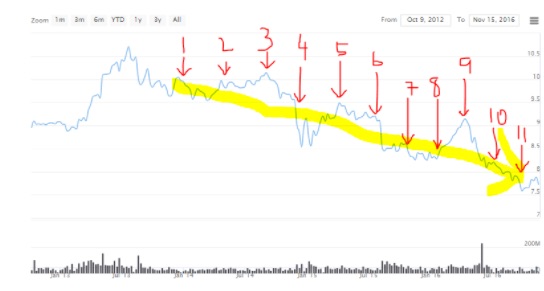
- The above is a price chart of a stock listed on Bursa Malaysia. As an investor focusing on Ringgit Cost Averaging, you are committed to invest in the stock on a quarterly basis, starting from Point 1 (January 2014).
- The stock’s lowest trading price was Point 11. This is lower than the average cost of your stock purchase made since Point 1, meaning an incurred paper loss on the stock price.
- When this happens, would you still be motivated to continue your plan to accumulate shares of the stock above, at Point 9, 10 and 11?
Most likely, you’d be disappointed and would be questioning the soundness of this investment technique. It seems ridiculous to continue the pursuit of this strategy if it is not working.
So, should I not consider Ringgit Cost Averaging as a viable method for investing?
Hold your horses!
Let us think about from a more practical perspective. Here, I’ve incorporated the Ringgit Cost Averaging investment technique into a simple and workable 5-step strategy which should theoretically help any working man or woman achieve financial freedom and retire comfortably in Malaysia.
Let us assume:
- You are 25 years old.
- You plan to retire at 55.
- You are able to set aside RM 1,000 a month for investing purposes.
Step #1: Set a Target
The first step is to set the targeted returns that we intend to achieve from our investment. It has to be specific and measureable. This will help us to narrow down our search for stocks that would fulfil our target. For instance, we may set:
Dividend Yields = Above 6% a year.
Note: Let’s put capital gains aside as the ups and downs in share price are based on market conditions beyond our control.
Step #2: Build a Watch List
Next, we’ll build a watch list of 10 – 20 stocks that can pay good dividend yields. How would we find them? It’s easy. Often, they share the following characteristics:
- These stocks grow profits consistently;
- They are cash-rich; and
- They pay dividends amounting to more than 80% of their annual earnings. (Dividend Payout Ratio > 80%).
Step #3: When Should I Buy?
For this part, we’ll need to monitor the prices of the stocks listed in our watch list. We should buy the stocks if the:
1. Dividend Yield > 6% a year.
Dividend Yield = (Annual Dividends per Share / Stock Price) x 100%
2. Stock price is starting trend upwards.
Basically, there are 3 different types of price trends. They are uptrend, downtrend and sideways trend. These movements are also known as Simple Moving Average or SMA. You may read more on SMA here: http://www.investopedia.com/terms/s/sma.asp. Eager to learn more? Try to read up on basic technical analysis tools such as the SMA-Crossover Method to help you identify the stock’s current price trend.
Step #4: When Should I Not Buy?
We may consider holding back on investing if:
1. Dividend Yield < 6% a year
Dividend yields are low when stock prices are high. Thus, by holding on to this rule, we would avoid buying shares when they are overpriced, reducing our risk of making investment mistakes.
2. Stock price is moving on a downtrend.
Let us say, in a specific month, we have already set aside RM 1,000 a month to invest. But, we couldn’t find an ideal investment.
In this case, we would just place the RM 1,000 into a designated account until the emergence of a new investment opportunity. If this situation continues, resulting in the accumulation of more than RM 5,000 in investable capital, you may also consider opening a 3-month or 6-month fixed deposit account to earn some interest.
What’s The Difference between a Traditional and Improvised Ringgit Cost Averaging Method?
By following the first 4 steps mentioned above, our stock portfolio will differ from someone who practises the traditional method of Ringgit Cost Averaging. The main differences are illustrated as follows:
1. Investor A (Traditional Ringgit Cost Averaging)
Investor A religiously sets aside RM 1,000 a month to accumulate shares in one company, known as Stock A.
2. Investor B (Improvised Ringgit Cost Averaging)
Investor B also sets aside RM 1,000 a month to invest. He invests based on the first 4 Steps mentioned above.
| Month | Investor A | Investor B | Month | Investor A | Investor B |
| 1 | Stock A | Stock A | 7 | Stock A | RM 1,000 |
| 2 | Stock A | Stock B | 8 | Stock A | Stock C |
| 3 | Stock A | Stock A | 9 | Stock A | Stock B |
| 4 | Stock A | RM 1,000 | 10 | Stock A | Stock D |
| 5 | Stock A | Stock B | 11 | Stock A | Stock A |
| 6 | Stock A | Stock C | 12 | Stock A | Stock B |
One year later, Investor A would accumulate lots of Stock A shares. Meanwhile, Investor B has built a diversified stock portfolio consisting of Stock A, Stock B, Stock C and Stock D. Investor B also has an extra RM 2,000 set aside to capitalize on future investment opportunities.
Thus, the first 4 Steps mentioned above are to accentuate the core strengths of Ringgit Cost Averaging while reducing the negative impacts which may arise from this technique. The similarities and contrasts between the two are highlighted below:
| Technique | Traditional Ringgit Cost Averaging | Improvised Ringgit Cost Averaging |
| Capital | Fixed | Fixed |
| StockSelection | Fixed onOne Stock | Wider Selection. Invest in stocks that fulfil iInvestment criteria. |
| Price | Price changes are not taken into account. | Buy if stocks are Cheap. |
| Risk | Fixed at One Stock | A Diversified Basket of Stocks |
| Result | Accumulation of shares in a company where average dividend yield and capital gains are uncertain. | Accumulation of a basket of stocks that pay above 6% a year in dividend yields |
Step #5: Start Early
Ringgit Cost Averaging favours investors who start early. From the above Steps, if you are 25 years old and choose to:
- Set aside RM 1,000 a month to accumulate stocks that pay 6% in dividend yields; and
- Reinvest your dividends to accumulate more stocks that pay 6% in dividend yields.
By age 55, you would’ve invested a total of RM 1.02 million which could generate RM 61,018 a year in dividend income. This works out to about RM 5,085 in monthly income!
| New Capital Invested | RM 372,000 |
| Dividends Reinvested | RM 644,970 |
| Total Investment | RM 1,016,970 |
| Dividends at Age 55 (Annual) | RM 61,018 |
| Dividends at Age 55 (Month) | RM 5,085 |
Meanwhile, if you choose to start at age 35, you would’ve invested RM 479,550. From this, your portfolio will potentially generate RM 28,773 in dividend income, which is equivalent to RM 2,398 a month.
| New Capital Invested | RM 252,000 |
| Dividends Reinvested | RM 227,550 |
| Total Investment | RM 479,550 |
| Dividends at Age 55 (Annual) | RM 28,773 |
| Dividends at Age 55 (Month) | RM 2,398 |

Thus, starting as early as possible is a fundamental aspect of Ringgit Cost Averaging.
On that note, Peter Lynch, former manager of the Magellan Fund at Fidelity Investments (the fourth largest mutual fund and financial services group in the world) said:
“In the long run, it’s not just how much money you make that will determine your future prosperity. It’s how much of that money you put to work by saving it and investing it.”
So, are you willing to put in all the effort required to save, invest and grow your money? If you are, what are you waiting for? Start young, start now, and start TODAY!
This article is sponsored by Securities Commission Malaysia, under its InvestSmart Initiative.

© Securities Commission Malaysia (SC). Considerable care has been taken to ensure that the information contained here is accurate at the date of publication. However no representation or warranty, express or implied, is made to its accuracy or completeness. The SC therefore accepts no liability for any loss arising, whether direct or indirect, caused by the use of any part of the information provided. The information provided is for educational purposes only and should not be regarded as an offer or a solicitation of an offer for investment or used as a substitute for legal or other professional advice. For enquiries regarding sharing, republishing or redistributing this content please write to: admin@investsmartsc.my.

7 replies to "Achieving Financial Freedom with Ringgit Cost Averaging"
I think monthly investment is good when you buying index ETF, not individual stocks.
This are method I’m currently using, just KC had laid the plan out clearly.
I’m saving stocks on monthly basis, I have bucket of shares which pay consistent dividends, good dividend yield, net cash, and growing equity at the same time.
Every month, either I average down, or average up. As long as a bucket of shares pay me good dividends, I sleep well at night.
Hi KC,
Most of the top financial books recommends setting up a system that automates this for you because normal wage earner are usually forgetful and lazy to manage their funds… Its a system that work! They do this mostly through ETF in the US.
I classified myself as middle income wage earner, I have some money put aside, but not enough to accumulate quick enough to “invest” in say stock/reit. this is because the brokerage fees in the end plays a role in the net return…
But at the same time, investment is also a race against time, the longer we accumulate the capital the less we’ll receive when we want to retire
I therefore opt for UT under fundsupermart, because they do automate the process somewhat but a lot of people are saying that UT is like the worst form of investment among all that is available.
Is there no other form of investment that can help us with RCA?
Hi KC,
Can I use this method at ut investment since i have learned more to ut rather than stock.
Yes. Dollar cost averaging strategy is very effective with unit trust.
Hi KC, the stock that gives high DY are mostly the high price stocks, what if the money we set aside is not enough to buy one lot?Does that mean we should buy unit trust instead?
Now stock listed on Bursa Malaysia can be purchased at 100 units lot. For stock that has single unit price >RM50, you will need RM5000.
However, there are stocks that is less than RM10 that has good dividend yield. That will require less than RM1000 to invest each time.