Let’s go back and look at the changes that have happened in the Malaysia financial planning industry.
In 2001, we have the start of a 10-year capital market plan.
In 2004, the Security Commission started the Investment Adviser’s License. For the first time, if a person wants to write or continue a financial plan, they will be required a license.
In 2006, Bank Negara Malaysia started the Financial Adviser’s License. This license is mainly for financial planners who want to offer advice on insurance.
Then in 2007, we have the CUTA license, which is mainly to allow financial services firms to offer Unit Trust funds. Since the issuing of the Adviser’s License, 9 years have passed. Where are we heading to in 2013?
Mr. Jason Ng Kwong Yong, Vice President, External Relations & Publicity of Malaysia Financial Planning Council (MFPC) shared about the trends that affect financial planners in Malaysia. Watch the short video below:
To understand that, you have to know the five organizations involved in the financial services industry. First, we have the MFPC or the Malaysian Financial Planning Council. This is the supporting body for financial planning certifications for things like the RFP (Registered Financial Planning), the Shariah RFP (Shariah Registered Financial Planning), and of course we have our friendly competitor, the FPAM or the Financial Planning Association Malaysia.
Then we have the Malaysian Financial Planners & Advisors Association which was formed before MFPC. This is the supporting body for practitioners who have the ChFC qualification. The ChFC or Chartered Financial Consultant program has been discontinued when RFP and CFP came into the market. That’s why I call it a dinosaur. But, of course, those who are interested in this can go to any center that is connected with them.
We have the two regulators. The first one is the Securities Commission which regulates the issuance of Capital Market Service License (CMSL) and the Capital Market Service Representative License (CMSRL). The other one is Bank Negara Malaysia who regulates the issuance of Financial Advisory License & Financial Advisory Representative License (FARL).
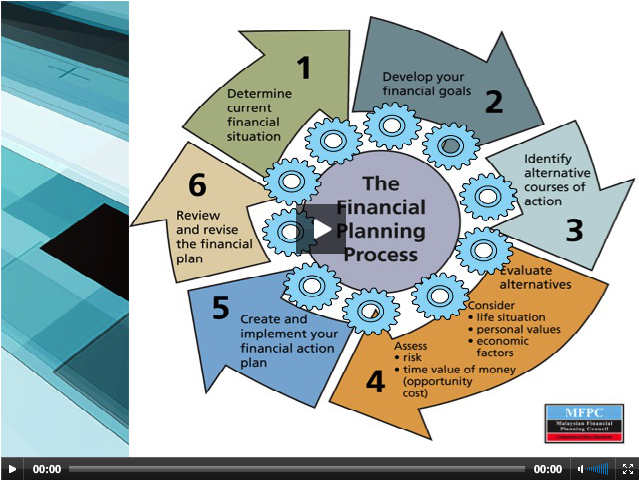
Now, let’s talk about the six steps in the Financial Planning Process. First, we have to look at the person and determine their current financial situation. Secondly, you develop the financial goals with the person. Then, we identify an alternative course of action. After that, you need to assess the risk and the time value of money. Time value of money means we look at the opportunity cost – things like what RM1 today will be worth in the future.
Then, we also look at the person’s life situation, his personal values, and his economic factor. From there, we evaluate alternatives. After evaluating, you then create and implement your financial action plan, which you will give to the person concerned to look at and assess. And we will review and revise the plan accordingly. Finally after that, will be the implementation.
With regards to Malaysia’s Financial Planning scene, we have to first develop the financial industry, and then improve the economy and increase the population income.
Now, looking at the Trends in the Malaysian Market, we can see the financial planning sector growing and evolving steadily. Banks and insurance companies have started offering financial planning services like will writing, wealth management, etc. The regulators have also demonstrated a need for change by imposing stringent licensing requirements such as professional qualifications like the RFP.
For Premium Webinar Members, you can watch the full replay of the webinar here: