

Darden Restaurants Inc (Darden) owns and operates branded restaurants in the US. As I write, Darden has a market capitalisation of US$ 17.4 billion. If this is to be converted into Ringgit, the size of Darden is comparable with Public Bank. As an ever-developing investor, I’d studied and would like to list down 5 things that I learnt about Darden. They are as follows:
1. Brands
Darden grew its restaurant count from 1,501 in 2014 to 2,031 in 2024. From it, I learnt that Darden has categorised its restaurants into 4 key business segments: Olive Garden, LongHorn Steakhouse, Fine Dining and Other Business.
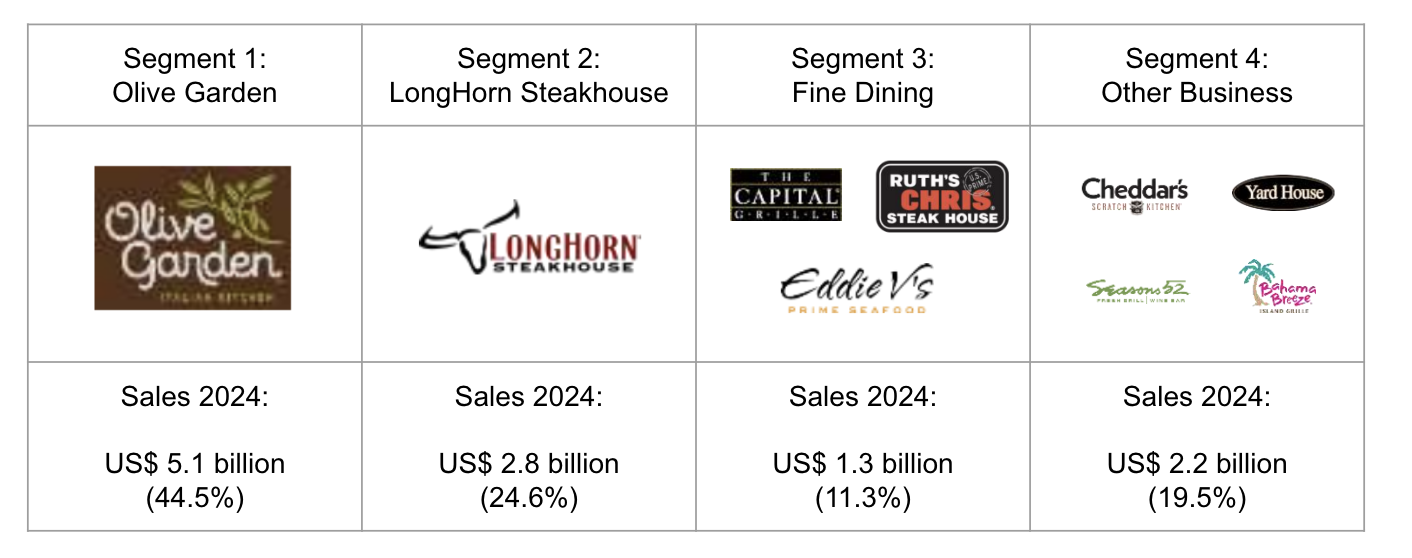
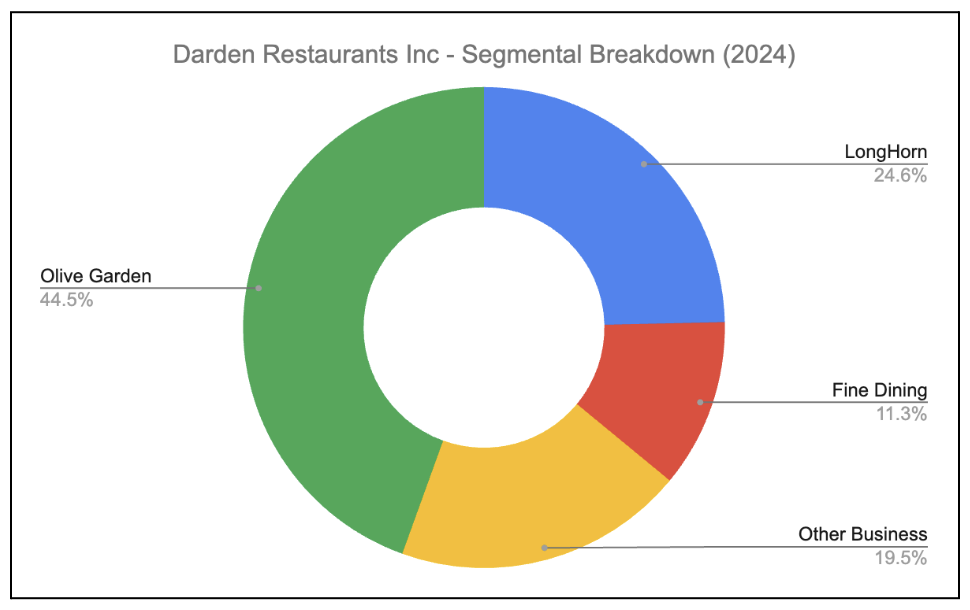
Olive Garden is now the largest Italian full-service dining restaurant in the US. It serves a variety of Italian food and imported Italian wines. In 2024, Darden runs 920 Olive Garden restaurants, which is an increase from 837 in 2014. It is now a key brand for Darden and accounts for 44.5% of Darden’s total revenue.
LongHorn Steakhouse is a steakhouse restaurant in the Eastern US. It features a variety of fresh items like steaks, chicken, salmon, shrimp, ribs, pork chops, and burgers. In 2024, Darden operates 575 LongHorn Steakhouse restaurants which is an increase from 464 restaurants in 2014. It generates US$ 2.8 billion in sales, thus, is the second largest sales contributor to Darden.
Darden’s Fine Dining segment includes The Capital Grille, Eddie V’s and recently acquired Ruth’s Chris Steak House in 2024. It is the smallest contributor of sales to Darden at 11.3% in 2014.
The Other Business is a segment which operates smaller fine-dining restaurants like Cheddar’s Scratch Kitchen, Yard House, Bahama Breeze and Seasons 52. For the year 2024, this segment made US$ 2.2 billion in sales to Darden.
Source: Darden Restaurant
2. Profitability
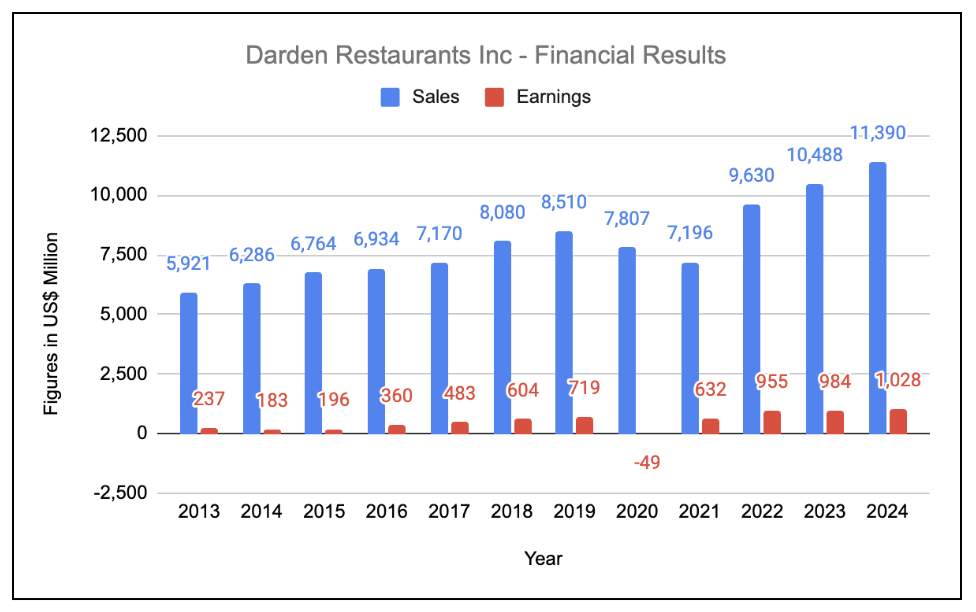
Overall, Darden attained growth in revenues and earnings for the past 10 years. The exception is for 2020 as it was impacted by COVID-19. With continuous rise in margins, Darden’s earnings had grown at a CAGR of 18.8% to US$ 1.03 billion in 2024 from US$ 183.2 million in 2014. This is despite revenue rising at a CAGR of 6.1% to US$ 11.4 billion in 2024 from US$ 6.3 billion in 2014.
3. Capital Allocation
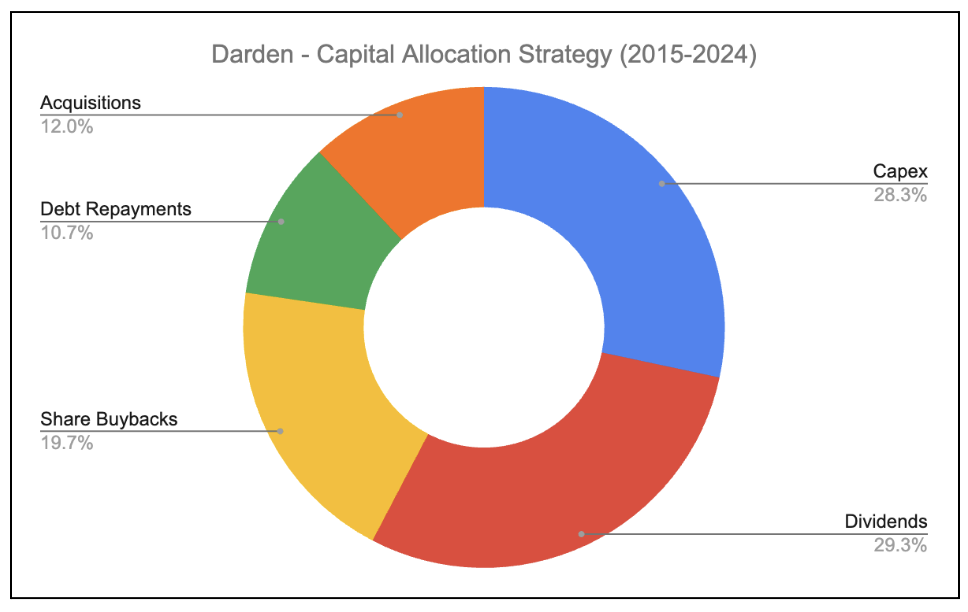
In 2014-2023, Darden brought in US$ 11.2 billion in operating cash flows. It had utilised it as follows:
1. US$ 3.8 billion on dividend payments.
2. US$ 3.7 billion on capital expenditures & softwares.
3. US$ 2.6 billion on share buybacks.
4. US$ 1.6 billion on acquisitions (Cheddar’s Kitchen and Ruth’s Chris)
5. US$ 1.4 billion on net debt repayments.
Hence, it shows that Darden prefers to allocate capital on growth activities such as Capex, share buybacks and acquisitions over paying out dividends in the past 10 years.
4. Ruth’s Chris + Future Outlook
On 14 June 2023, Darden acquired Ruth’s Chris for US$ 724.6 million. This is the largest acquisition made since it acquired Cheddar’s Scratch Kitchen in 2017 for US$ 799 million. Ruth’s Chris generates US$ 500+ million in sales in 2022 from a portfolio of 81 owned-restaurants and 74 franchised-restaurants. Ruth’s Chris is now parked under Segment 3: Fine Dining.
Moving ahead, Darden offered its outlook for the year 2025. It plans to open 40 to 50 restaurants in 2025 and budgets US$ 550-600 million in Capex. The board had approved a 7% increase in quarterly dividends to US$ 1.40 a share. This will work out to be US$ 5.60 in dividends per share (DPS) for the year 2025.
5. Valuation
Excluding 2020 (COVID-19), Darden’s P/E Ratio average is 23.5 (2015-2024). The company’s 10-year P/OCF (Price-to-Operating Cash Flows) averages at 11.9. The average dividend yield in that 10-year period for Darden is 2.89% per annum. In essence, the key is to ensure that Darden’s current valuation is below 23.5 in PE and below 11.9 in P/OCF before considering an investment into it.
Conclusion:
Darden has a decent track record of growing its restaurant businesses and thus, delivered continuous rise in sales, profits and operating cash flows over the last 10 years. The exception is for 2020 as it was impacted by COVID-19. In 2020, its share price tumbled by nearly 70% and hence, presented an opportunity to buy its shares at discounted prices. As investors, it is wise to compare Darden with a handful of listed peers in similar industries such as Chipotle and Domino’s, prior to making an investment decision.
Here, if you intend to build a Growth-based Portfolio filled with the top 1% companies listed in the United States, check out our free 1-Hour online webinar training on growth investing:
