

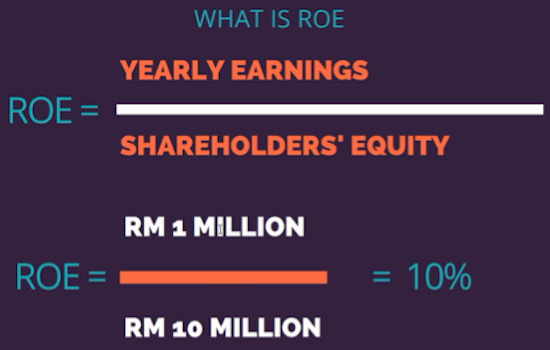
Return on Equity (ROE) is one of the most widely-used indicators to assess the quality of a stock. It is calculated by dividing a company’s shareholders’ earnings with its shareholders’ equity. ROE tells investors how effective the company is in using capital to make more money to shareholders. Usually, high ROE companies would contribute positively to their market value over the long term. This is because these stocks are high-in-demand among investors.
Here, I would share how I use ROE personally to assess stocks for investment. They include:
1. Track Record
First, I would calculate & look into a company’s ROE for the last 3 – 5 years. 3 years are for companies that are recently listed. Meanwhile, 5 years are for companies which have been listed for more than 5 years. Here, I’m looking at a company’s track record in using its existing capital in making profits to its shareholders.
I would probably give a ‘Thumb Up’ if a company is able to maintain ROE of above 10% per annum. I would exclude a company from my radar if the company has declining ROE figures despite achieving above 10% per year in ROE for the last 5 years.
2. Market Value
Next, I would compare a company’s ROE with its market capitalization. Usually, consistently high ROE companies would attract more investors. High demand in these shares would lead to higher prices over the long-term. If the company’s value grows in tandem with ROE, then, they would be included in my radar.
3. Calculating ROI
ROE is a key ingredient to calculate my expected ROI before investing in a company’s shares. What’s the difference between ROE and ROI?
ROE is for existing owners of the company. They are earlier investors who had already invested into the company. For example, let’s say, a group of investors have invested RM 1 per share in a company’s share. The company makes RM 0.10 per share. Then, this group of investors make ROE of 10%.
ROI is for new investors who have yet to buy the company’s shares. For instance, if shares of the company mentioned above is RM 2 per share. I intend to buy these shares at RM 2 per share. Then, my ROI would be 5% if the company continues to make RM 0.10 per share.
Despite its usefulness, I believe ROE has its flaws. Hence, I would dwell into a company’s accounts to further. After compiling data of 700 – 800 stocks, I would like to share 2 incidents when high ROE is not necessary good news and a sudden drop in ROE is also not necessary bad news.
1. Non-Operating Gains
A company may inflate ROE by inflating earnings. This is done through recognizing non-operating gains into the company’s earnings. Usually, they are one-off in nature. These gains include substantial gains from disposal of properties, plant, equipment, subsidiary, associate and even joint venture companies.
Also, ROE can be inflated by recognizing ‘Fair Value’ gains of investment properties and even properties. This can distort your decision making when considering the company’s shares for investment.
For example, a hotel operator may incur operating loss of RM 1 Million in a particular year. In that year, the hotel building was revalued from RM 10 Million to RM 12 Million, achieving RM 2 Million in capital gains. Capital gains are non-operational gains.
As a result of recognizing the RM 2 Million in gains, the hotel operator may report RM 1 Million in net earnings instead of a loss of RM 1 Million. This would look good on the hotel operator’s accounts. Hence, it is something I would beware of.
2. Capital Injection
A company may report a sudden drop in ROE. This is because a company had enlarged its shareholders’ equity substantially. For instance, a highly profitable company with high ROE figures may raise additional funds through private placement and rights issue to further expand its business. The sudden increase in shareholders’ equity would dampen a company’s ROE at the short-term.
In this case, the drop in ROE may not be bad news. I would probably download the company’s prospectus for the Rights Issue. From which, the prospectus would reveal valuable information on the company’s future prospects in great detail.
