
On the Tuesday of 10 September 2013, Ilja and Ken interviewed the young, multi-talented, energetic and fast-talking journalist-cum-entrepreneur Ms Joyce Ng. Ms Ng, a Malaysian, is the founder and 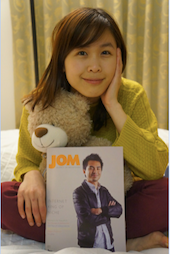 editor of JOM Magazine,which according to her, is the first and only Malaysian community magazine in Australia. The bi-monthly English publication features stories, news, articles that cater for Malaysians in Australia and anyone else who has an interest in things Malaysian.
The magazine is such a welcoming surprise to us as this is the first time we see a Malaysian magazine in Melbourne. Before her JOM days which started in 2012, Joyce had been working in the media industry and also taken an acting role with Mediacorp of Singapore.
The story of Joyce and JOM is a perfect example of someone doing what she is truly passionate about. We first came across JOM two months ago at a Malaysian restaurant called Grand Tofu located in Kingsway, Glen Waverley one Sunday morning. We were eating yong tau fu there. It was an issue which had what it described as the indomitable Ambiga on the front cover. Within seconds of holding this magazine, we knew we had to interview the person behind this publication.
When asked what have been and still are some of her biggest challenges, Joyce categorically answered with three words that so succinctly captured the challenges most entrepreneurs face – people, time and money. These, according to Joyce, are the most challenging obstacles and yet the important ingredients for success.
Considering JOM started out without any external funding and borrowings and also that fact that her team consists of a lot of young volunteers, the fact that JOM has existed, after six publications, for one full year now does say a lot about her capability as an entrepreneur and her charisma as an effective leader.
Her resourcefulness became evident to us when she revealed to us that her JOM team does not only generate revenues from advertising but also from providing marketing services to their clients such as graphic design, copy-writing, video-editing and a whole range of marketing-related services.Her team has also branched out into running events with the inaugural Melbourne Malaysia Festival in November 2013, which helped raise funds for underprivileged children in Malaysia.
We also asked Joyce what sort of ‘advice’ she would give to anyone (especially Malaysians) who wants to settle in Australia, to which she suggested that they should also be open to other cultures. She encourages new migrants to make full use of the multi-cultural and multi-nationality qualities in Australia.
Joyce wanted to thank her team and all the people who encouraged her along the way. She also thanked her lecturers from her university days. Special thanks of course went to her beloved family and she singled out her mother as being her very good role model.
We really appreciate her time and generosity in giving us her very interesting interview despite her very busy schedule. Three weeks after coming back from Malaysia, she was off to the airport again right after our interview with her yesterday.
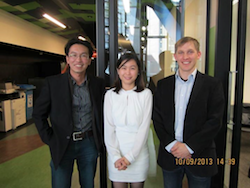
Congratulations Joyce!
Transcript of our video-recorded interview:
Ilja:Hi Joyce, thank you very much for taking your time off for this interview.
Joyce:That’s ok. You are welcome.
Ilja:Could you tell us where you are coming from and why do you do what you do, ie is such a beautiful magazine (Jom)?
Joyce: It can be a long story of an hour or two or a short story of a minute or two. Hahaha… (laugh). I would just say it in a more concise manner. Basically from young age I like media. I always have a fascination about media, about TV.
I have studied a degree in media and communication in Monash and Master in RMIT which I did not finish. Yes, because I wanted to start working and doing what I love rather than studying and not getting anywhere at the time.
Ilja:That reminds me of Bill Gates which he didn’t finish his university because he wanted to work straight away.
Joyce:Because I already have a degree from Monash then move on to Master in RMIT then I realized the course is very similar and the fees is very expensive and it cost almost AUD30,000 a year.
Why am I in Australia? Actually that’s some reason in Malaysia that push me to Australia. Actually there’s push and pull factors (for me to come to Australia). Basically is hard for me to achieve my dream there at that time. My parents are quite protective, they think is not a save place to do what I want there.
Ilja:Do you mean in terms of the environment there?
Joyce:Yes, in terms of security – personal and physical safety. Because being a journalist, it requires long hours of work being outside. And working hours might not be regular and for example you might end up in odd hours at the car park and someone might rob you.
Yeah, my mom is very cautious about safety. That’s one of reason why I’m here (in Australia). Also I also met someone, who is an Australian citizen, and we going out together now. And there’s also the love story there that’s why I’m here.

But it doesn’t mean I’m not passionate about my home country. I still love my country and I think I still have a dream that I haven’t fulfill yet. That’s why I start JOM Magazine.
Ilja:Is this dream of yours connected to this magazine?
Joyce:Yes because my dream is to work in media. I like service and disseminate information. Maybe also the glamour factor…I don’t know.
Maybe it’s a mix of everything! But I’m always being fascinated by media and so I want to try out if it’s possible here. I have some experience in media in Malaysia. I did a bit of acting for Mediacorp Singapore. And when I came to Australia, I work for a media agency and also as a graphic designer in another company. And I was a journalist intern for my last year in university.
And I was an editor in university as well. And one day when I came back from Malaysia, and I met a stranger at Melbourne airport. He is a journalist, he writes for a lot of Asian magazines in Australia, such as Philippines, Korean, Hong Kong, Chinese magazines.
Then I ask him why he’s not writing for a Malaysian magazine. Then from his reply, I came to know that there isn’t a Malaysian magazine in Melbourne. When I was studying university here, I didn’t see any Malaysian magazine. I was looking for one when I was studying here.
Then I ask him “Why isn’t there one in Melbourne?”. Then he said, “We will start one”. And that’s how it all started! Actually is a decision made between two strangers at the Melbourne International Airport.
Ilja: That’s a great story!
Joyce:Hahaha…I don’t know, he is a very experienced guy he is like fifty, sixty years old. He is actually the one who pushed me. He will call me on an off to see how’s the progress of starting the magazine.
Ilja:So you have to be quite comfortable with him right?
Joyce:Actually he is quite pushy. I think he is trying to stimulate the spirit in me.Like this young person you know, I got to push here and he keep calling me.
Because at the start I did have doubt, like is this going to work because there’s no such thing (a Malaysian magazine). I did ask other people with a lot of experience for their opinion, and their feedbacks are like, “No, you don’t need this.
There’s online now, you know”…. and all the negative feedback. But it so happen at that time, my visa doesn’t allow me to be employed.
Ilja:Was it a long time ago?
Joyce:That’s in 2011 and part of 2012. And Jom Magazine started at 2012 and it started when I couldn’t be employed. And that is a very good excuse for me because I couldn’t be employed in paid employment, so I couldn’t find a job.
Isn’t it the best time to do something that you like and just to try and see, right? That’s very good excuse, because my family will ask,“Why don’t you find a job?”And then I could say, “I cannot find a job (because of my visa restriction)…”
Ilja:Like you got nothing to lose?
Joyce:Yes…a part from a bit of time, effort and money. But yes, we started with just two of us, the “stranger” and me. Then I ask my friends whom I trust if they know anyone who can do this and do that. That’s how we pulled the strings together.
And another factor is that a lot of us are young, twenty-something, except for the “stranger” who is fifty-something. That’s one factor that allows us to try out new things.
Ken:What we like about your magazine is that you position it very well.It serves as a gateway for people in Australia who are interested in Malaysia and vice versa.
I think that strikes just as why we haven’t thought of that and there’s a need for this. Rather some other Asian magazines that we have seen is very much advertisement oriented.
Joyce:Oh, thank you so much. That’s how we want to differentiate ourselves also. We want to create a product that the content has substance in it rather than one that is full of advertising. And we try to imitate local Australian magazine as well.
That’s why the paper we use is like that and our layout looks neat as well unlike those Asian magazines that often look fluffy. And we publish in English, so anyone who read English can read (our magazine). And Malaysians are comfortable with English anyways and we converse in English here most of the time.
Ken:We like the fact that it’s for Malaysians and it’s also for anyone outside Malaysia as well. Like Ilja, our partner who is also very interested in expanding his organization to Malaysia as well.
Joyce:And there’s a huge Malaysian population here in Melbourne. And that’s one of the reason I think we should have a Malaysian magazine in Melbourne. It’s strange, if you take every Chinese magazine in Melbourne, from each edition and you pile it up it will weight almost 10kg.
There’s so many Chinese magazines and newspaper here, even Thai and Philippines. Japanese you got quite a few and Korean you got at least 5 or 6. How many are there here and they have so many magazines whereas Malaysian has such a huge population here but there’s not even one Malaysian magazine.
Ilja:That’s interesting…
Joyce:Yeah, that’s interesting. You see, that’s another “excuse” for us. Maybe we should start one Malaysian magazine right? So we should try it….But the truth is we are not the first one who try it, but we are the first one who made it.
There were attempts to try to produce a Malaysian magazine, but there didn’t make it to produce anything. They tried, but I don’t know what happen, it didn’t work. We are the only one who produce a Malaysian magazine in Australia.
At the moment, we haven’t seen anything like this anywhere in the world. No one has actually come and tell us, oh I’ve got something similar. And we also met a lot of prominent people, such as Foreign Minister of Malaysia, who actually travel around the world to meet Malaysians all around the world. And he said he hasn’t seen anything like this.
Ilja:That’s fantastic! Congratulations:
Joyce:Thank you. Basically it’s a diaspora magazine also, for people in a country far away from home.
Ken: Can you also run us through some of the experiences that you have in your first month of operation, such as your first interview?
Joyce: Oh, the first interview is actually a disaster…He’s a big shot and a popular person in Malaysia. He is a DJ and Youtube star. People call him GiniBoy.
That was our first interview, but it was a disaster. We were too fans like….people were looking at us that we don’t look professional. I was trying so hard to hold my feeling. But it was fabulous we have a cute souvenir for him, we were a bit late. Because we were lacked of experience, we didn’t actually tell them before-hand what we were going to do, there’s some miscommunication there.
But we learn a lot from there. And Giniboy was very humble as well and he was very accommodative. He answered all of our questions, so there’s good and bad.
Ken: Wonderful…
Joyce: And you were talking about the first month of operation. At that time we thought it was a good time to produce a magazine. This is because it was close to the 55th Malaysian Independence Day.
Last year (2012), it was the right time to do it. And also I’m not doing much at that time, so I also push myself to do this magazine anyways. We didn’t look for any investor. There wasn’t any financial backing. We almost like a grass root then, we did it ourselves with our own pocket money.
Ilja: And with freelancers as you mentioned before?
Joyce: All these people are volunteers. But they are inspired and we were creating something that did not exist. We got a lot of support from volunteers to write articles and stuffs. And we also got legal and accounting advice. That’s why we registered as a company not as a non-profit organization.
Why?
For some legal and accounting purposes which I won’t go into detail for now, they said is better for you to register as a company but that’s how we started, we started as volunteers and registered as a company.
Ken: I think it takes a lot of your personal charisma to mobilize so many people to achieve a shared goal.
Joyce: Yes, you need to confident, you need to inspire people, you need to tell them your vision, so people will follow you and people will like you and I guess that’s what a leader has to do.
Ilja: What is your vision basically?
Joyce: My vision is pretty simple, that is to have a media platform which is credible and recognized by many people for the Malaysian community here and also for non-Malaysians that want to know about us, as easy as that.
And also for Malaysians in Malaysia that want to know what we are doing here and how we are feeling over here. We share stories and news updates. My vision is pretty much the same still. It’s just a matter of spreading and growing it.
Ken: The next question would be what is your biggest obstacle along the way?
Joyce: I’ve got a lot of challenges, but we can come up to 3 main ones. And I think in any business, it’s always this three – the people, the time and the money. They are the most challenging but also the most important. They are the key to success. If you don’t tackle any of these well, you will lose.
Among this three, that is the most challenging one, for me is money because we started off without any financial backing. I think all these three are link together, you see. We have no investors. Actually we have been so busy until today.
We don’t have time to look for investor. Actually we have heard of someone who wants to invest in our company, but we still too busy until we haven’t got time to do a proper proposal for this person. So I think money is the most important challenge for us right now.
Ken: What are the 3 pieces of advice that you want give to Malaysians who are planning to come to Australia?
Joyce: It really depends on what your reason is for coming to Australia?
Ken: Coming to Australia to settle down, coming to Australia to fulfill their dream?
Joyce: Is actually very personal, everyone could be different. People will always think the grass is greener on the other side. In Chinese, the moon is brighter on the other side. But in reality, is not always the case until you actually experience it, until you actually come here. Then, you will know it, you see? My advice is not to be too Malaysian sometimes.
You need to learn a lot about other cultures. There are a lot of things to learn. I think Melbourne is a great city and it is a great place for you to learn about a lot of other cultures, and to learn about tolerance and openness. If you can adapt to these things, yes, I think you can stay here.
Ilja: Can you elaborate more on “not to be to Malaysian”, what you do mean specifically?
Joyce: Don’t always stick back to your own group of people. Try to mix with and
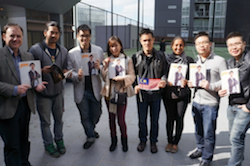
learn from people from other cultures. Try to explore your life as in you are exploring the place as well and vice versa.
And do not to be too ‘being in your own world’. Everyone has left the country for different reasons. It really depends on the reasons and causes.
Ken: Can you list some people that have inspired you and the people that you want to thank?
Joyce: Well some lecturers from my university days. They put the passion and fire in me. A lot of positive comments from them such as, “You are a great person, you have a clever vision, you can do better…” I didn’t like my life at that time. I was helping at a printing shop that gave me a place to stay.
The job was actually boring. I was like the receptionist that attends to customer printing requirements. It was like a ceiling that limits my potential. It was not what I wanted to do. I felt very restricted. It didn’t inspire my passion or things that I wanted to do. Actually doing this magazine is one of the excuses to run away (from that boring situation).
Actually at that time, those encouraging words from my university were actually playing a lot in my head. I got the motivation from them constantly telling me that I can always do better. There are two lecturers, one of them teaches in Malaysia. Another one actually writes for our magazine. He is very supportive. He actually volunteers to write for a column in our magazine without me asking him. I was so grateful for of support. I still seek his advice now and then.
Ken: What is his name?
Joyce: Julian Lee. He writes a column that he named “KurangManis”.
Ken: Oh, “KurangManis”, I actually read that in your magazine.
Joyce: Yes, that’s him. He was my lecturer in Monash. Now he is teaching in RMIT. He’s a really intelligent person and he writes really well. And actually my family shaped my personality as well. My mom is a very intelligent person and she is very helpful to other people as well.
She’s a teacher, a great teacher. She’s very open and she’s very talkative. I have learnt a lot from her. And of course, my team! People who actually believed in what I do and they have been fantastic.
Ken: I think it works both ways. They are also very appreciative of you for sharing with them your vision.
Joyce: Thank you. I think living in another country really burns your purse. You have to constantly worry about the rent. If you don’t pay them well, they will leave. Even though they believe in me and a lot of them will feel sorry for me actually. Because they can’t do much, that’s why I said money is a problem.
And I think human capital is very expensive. We have very limited capacity now in employing full time staff.
Ken: Do you see any ways to overcome this problem?
Joyce: Yes, I did think of giving up.
Ilja: what did you do to overcome this feeling of giving up?
Joyce: Be calm and think through and ask if I can still hang on? To find out what my real purpose of doing this. I also asked my friends whom I can trust and move on.
In order to overcome the lack of finding, we partner up with our printers. I also earn our revenues by providing ideas and lend our marketing experiences and expertise to our clients and suppliers.
Ilja: I see.
Joyce: We are also planning to expand our services in video production. At some later stage, we will incorporate this in our magazine business too, although we wouldn’t call ourselves a marketing consultant.
Ilja: How do you motivate and encourage your team.
Joyce: we need to find out why they are doing what they do.
Ilja: You mean making them see the connection between them and the company?
Joyce: Oh yes, I have one team member who is medical student. She sees this as an avenue to serve the Malaysian people and to articulate her thoughts and ideas.
There is another type of team members who really see this as a viable business venture. They see the money in it.
Ilja: That’s interesting.
Joyce : Any more questions?
Ilja: That’s all for now. Thanks so much for your time.
Ken: Thank you so much, Joyce.
Joyce: Pleasure.
This article contributed by Ken Soong & Ilja Thomas Gull, writers for Making It in Australia: Success stories from different walks of life (completes by end of 2014)
